Beyond Play: How Building Blocks and Magnetic Tiles Shape the Mind of a 6-Year-Old
Introduction: The Quiet Revolution in the Playroom
At first glance, a pile of wooden blocks or a set of magnetic tiles might seem like simple toys—colorful, harmless, perhaps even a little old-fashioned. But for a six-year-old, these objects are far more than entertainment. They are the raw materials of cognitive architecture, the first concrete tools for understanding geometry, physics, planning, and even social cooperation. At an age when a child’s brain is pruning neural connections at a breathtaking rate, the choice of play material matters deeply. Building blocks and magnetic tiles occupy a unique space in early childhood development because they are open-ended, forgiving, and infinitely variable. Unlike a battery-operated toy that performs one fixed function, these construction sets demand that the child become the engineer, the architect, and the storyteller. This article explores why these seemingly simple playthings are among the most powerful learning tools for six-year-olds, how they support core developmental milestones, and what parents and educators should look for when selecting them.
The Developmental Landscape of a Six-Year-Old
To understand why building blocks and magnetic tiles work so well, we must first appreciate where a six-year-old stands developmentally. At this age, children typically have entered a period of rapid cognitive expansion. Piaget’s preoperational stage is giving way to concrete operational thinking. They can now hold multiple variables in mind, understand cause and effect more clearly, and reason about physical transformations. Their fine motor skills have improved enough to handle small pieces with precision, yet their attention span is still relatively short—often no more than twenty minutes for a single activity, though it can stretch longer when they are deeply engaged.
Socially, six-year-olds are learning to collaborate, negotiate, and share leadership. They become acutely aware of fairness and rules. Emotionally, they can experience frustration when a tower collapses, but they are also beginning to develop the resilience to try again. The right construction toy capitalizes on all these emerging abilities: it challenges their hands, engages their logic, invites cooperation, and offers a safe environment for failure and iteration.
Why Building Blocks and Magnetic Tiles Are Not Interchangeable
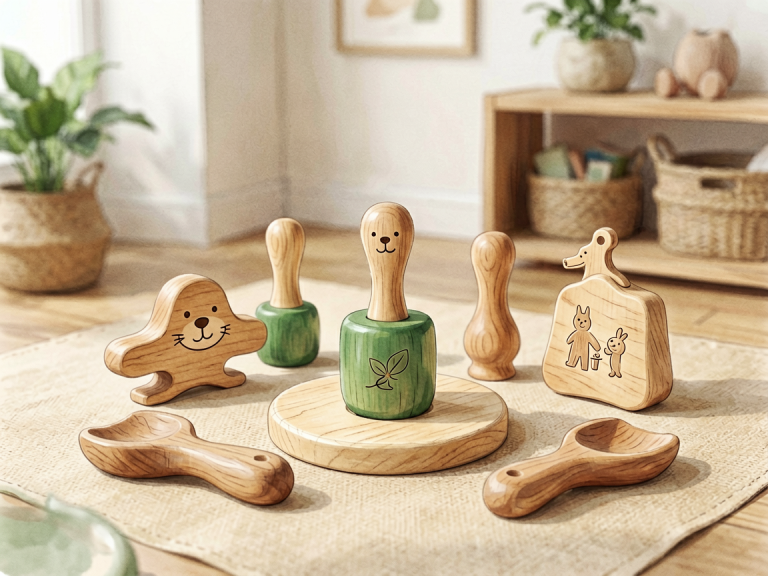
One of the most common questions parents ask is whether to invest in traditional wooden blocks or modern magnetic tiles. The answer is that both have distinct advantages, and ideally a child should have access to both. Wooden blocks—often made of solid hardwood, without magnets or connectors—rely entirely on gravity, friction, and precise alignment. They teach a child about balance, weight distribution, and the unforgiving nature of stability. A six-year-old quickly learns that a block placed too far to the left will cause the whole structure to tip. This is a visceral lesson in physics that no screen can replicate.
Magnetic tiles, on the other hand, use embedded magnets along the edges to snap pieces together. They lower the barrier to construction: a child can create a cube, a ramp, or a tower with far less manual dexterity than blocks require. This makes them especially appealing for children who may feel discouraged by the precision needed for block building. Magnetic tiles also allow for quick iteration; a failed wall can be reassembled in seconds. Moreover, because the tiles are translucent and come in bright colors, they naturally invite light-play and pattern-making. For a six-year-old who is beginning to explore symmetry and design, magnetic tiles offer a faster, more forgiving path to complex structures.
In short, blocks teach patience and gravity; magnetic tiles teach geometry and creativity. The best playroom includes both.
Cognitive Benefits: Engineering the Young Brain
Spatial Reasoning and Mathematical Thinking
One of the most robust findings in developmental psychology is that early construction play boosts spatial reasoning—the ability to mentally rotate, visualize, and manipulate objects in three dimensions. This skill is strongly correlated with later success in STEM fields. When a six-year-old builds a bridge out of magnetic tiles, she must decide how tall the pillars need to be, how wide the arch should span, and whether the structure will bear the weight of additional tiles. She is, in effect, conducting a rudimentary engineering analysis. Similarly, when she stacks wooden blocks to match a picture of a castle, she must plan the sequence of placements, estimate distances, and adjust for instability. Research by Dr. Nora Newcombe at Temple University has shown that children who engage in frequent block play outperform their peers on tests of spatial visualization. For six-year-olds, this is a golden window: they are old enough to follow multi-step plans but young enough that their spatial cognition is still highly plastic.
Problem-Solving and Executive Function
Building a stable structure is a problem in itself, but the real cognitive workout comes from failure. A six-year-old who watches her tower of magnetic tiles topple learns to ask: Was the base too narrow? Did I place a tile at an awkward angle? Could I add cross-bracing? This process of hypothesis, test, and revision is the essence of scientific thinking. Moreover, it exercises executive functions—particularly inhibition (not throwing the pieces in frustration), working memory (remembering the original plan), and cognitive flexibility (trying a completely different approach). These are the same skills that predict academic readiness and self-regulation in classrooms. Unlike many school tasks, which are often directed by an adult, construction play puts the child in charge of the entire problem-solving cycle.
Language and Narrative Development
It is a mistake to think of blocks and tiles as purely mathematical objects. Six-year-olds naturally create stories around their constructions. A square castle becomes a princess’s fortress; a long line of tiles becomes a race track; a tilting tower becomes a skyscraper in a storm. When children narrate their play, they practice sequencing events, using descriptive vocabulary, and imagining cause-and-effect narratives. If a parent or sibling joins in, the play becomes a collaborative storytelling session that builds conversational skills and perspective-taking. For a six-year-old, the question “What is happening here?” is often more valuable than “How many blocks did you use?”
Social and Emotional Growth
Collaboration and Conflict Resolution
Six is a prime age for learning to play with others, but it is also an age of strong opinions. Construction play provides a natural arena for negotiation. Two children with a single set of magnetic tiles must decide who builds what, whether to work together on one large project or build separate towers, and how to share the limited triangular pieces. These moments are rich with social learning: they practice turn-taking, compromise, and even apology when a tower is accidentally knocked over. Importantly, the cooperation is often motivated by the project itself—the children want a bigger, better structure than either could build alone. This is “cooperative play” in its purest form, and it builds the foundation for teamwork in school and later life.
Resilience and Emotional Regulation
A six-year-old who builds a magnificent castle only to watch it fall is experiencing a miniature version of loss. How they handle that moment matters. The best response is not to swoop in and fix it, but to offer encouraging words: “That was a great try. Can you think of why it fell?” Over time, repeated experiences with construction failure teach emotional resilience. The child learns that disappointment is temporary and that rebuilding can be even more satisfying than the original. Magnetic tiles, because they are so quick to reassemble, are particularly effective for building this kind of emotional muscle. The child can pick up the pieces and start over in seconds, which shortens the recovery time and keeps the play positive.
Fine Motor Skills and Hand-Eye Coordination
While six-year-olds have better fine motor control than preschoolers, they still benefit enormously from activities that require precision. Aligning a wooden block so that it sits perfectly flush, or clicking a magnetic tile into place at exactly the right angle, demands controlled hand movements, finger strength, and visual-motor coordination. These are the same skills needed for handwriting, typing, and many sports. Unlike worksheets or tracing exercises, block play is intrinsically motivating; the child doesn’t repeat a motion because they have to, but because they want to place one more tile on top. This repetitive practice is far more effective when it is self-directed.
Choosing the Right Construction Set for a 6-Year-Old
Material and Safety Considerations
For wooden blocks, look for sets made from solid hardwood (beech, maple, or birch) with non-toxic, water-based paints or stains. Avoid cheap particleboard blocks that can splinter or chip. The edges should be sanded smooth, and the blocks should be large enough to pose no choking risk—though by age six, choking is rarely a concern unless they are very small. For magnetic tiles, check that the magnets are securely encased (not loose) and that the plastic is BPA-free and shatter-resistant. Some magnetic tile brands have been recalled for weak magnets that could detach; invest in reputable companies like Magna-Tiles, Picasso Tiles, or Magformers. A good set for a six-year-old should include squares, triangles (both right-angle and equilateral), rectangles, and perhaps arches or half-circles.
Size and Quantity
A six-year-old is ready for more pieces than a preschooler. A set of 100–200 wooden blocks or 100–150 magnetic tiles is ideal. With fewer pieces, the child will quickly exhaust the possibilities and become bored. With too many, they may feel overwhelmed. A good rule of thumb: choose a set that allows construction of a structure at least as tall as the child’s own height. For magnetic tiles, also consider including a set of themed expansion packs—wheels and axles, for example, allow the child to build moving vehicles, which is a huge draw for this age group.
Open-Ended vs. Themed Sets
Avoid sets that are designed to build only one specific model, like a dinosaur or a car. These are not construction toys in the true sense; they are assembly puzzles. Once built, the child has little reason to take them apart. The magic of blocks and tiles is their open-endedness. A set with many identical basic shapes encourages unlimited creativity. The only exception is a set that includes a few “special” pieces (like windows, doors, or wheels) that add variety without constraining play. For a six-year-old, a set with a few decorative elements can spark imaginative storytelling.
How to Extend Play: Ideas for Parents and Teachers
Challenge Cards and Building Prompts
While free play is essential, some six-year-olds benefit from gentle prompts. Print or draw simple challenge cards: “Build a bridge that can hold a toy car,” “Make a tower that is exactly 12 tiles high,” “Create a house with a roof that slants.” These tasks add a problem-solving element without dictating the entire build. The adult should act as a consultant rather than a director, asking questions like “What do you think will happen if you add one more block here?”
Integrating Literacy and Math
Construction play can be seamlessly woven into other subjects. Ask the child to count how many blocks are in their tower, then write the number. Have them sort tiles by shape and make a bar graph. Use magnetic tiles to build letters and spell simple words. For a six-year-old, seeing that the letter “A” can be formed from two diagonal tiles and one horizontal tile is a powerful concrete representation of abstract symbols.
Group Challenges
In a classroom or playdate setting, organize a “building contest” where teams must work together to build the tallest structure, the strongest bridge, or the most creative design within a time limit. This encourages communication and delegation. It also provides a low-stakes way to practice handling disappointment when another team wins.
Conclusion: The Foundation of a Lifetime of Learning
The humble building block and the magnetic tile are not just toys. They are the first laboratories where a six-year-old experiments with gravity, geometry, and grace under pressure. They teach that failure is not the end but the beginning of a better design. They invite collaboration without coercion and creativity without instructions. In a world increasingly filled with screens that provide instant but passive gratification, these physical, hands-on construction sets offer something irreplaceable: the chance for a child to hold the world in their hands and reshape it, one block at a time. For parents and educators who want to nurture a child’s natural curiosity, independence, and resilience, there is no better investment. Give a six-year-old a pile of blocks or a box of magnetic tiles, and you are not just giving them play. You are giving them the tools to build their own mind.