Beyond the Box: Parent-Approved Alternatives to Traditional STEM Kits That Spark Real Learning
Introduction
The modern parenting landscape is flooded with glossy STEM kits promising to turn toddlers into little engineers, chemists, or coders. Yes, these kits can be convenient: everything comes in a box, the instructions are pre-printed, and the mess is contained. But many parents quickly discover that the magic fades after the first two experiments. The materials are often single-use, the activities are too prescriptive, and the price tag—often $30 to $60 per kit—adds up fast. Worse still, children may memorize steps without truly understanding the underlying principles, turning genuine discovery into a paint-by-numbers routine.
That is why a growing number of thoughtful parents are seeking alternatives: ones that are open-ended, reusable, low-cost, and—most importantly—approved by the very adults who have to clean up the aftermath. These alternatives don’t come in a shiny box from a toy company; they emerge from what is already around the house, the backyard, or the local hardware store. They invite trial, error, and the kind of messy creativity that standard kits often discourage. Below are five parent-approved alternatives that not only teach core STEM concepts but also foster curiosity, resilience, and genuine ownership of the learning process.
—
1. The Kitchen Laboratory – Science with Salt, Baking Soda, and Vinegar
Why Parents Approve
The kitchen is the most accessible laboratory in any home. Parents love it because the ingredients are cheap, non-toxic, and already on the shelf. There is no plastic packaging to discard, no tiny pieces to lose under the refrigerator, and no proprietary chemicals that vanish after one use.
What It Looks Like
Instead of a pre-packaged “volcano kit,” hand your child a tray, a few tablespoons of baking soda, a bottle of white vinegar, and some food coloring. Let them explore: what happens if you add the vinegar slowly? What if you freeze the baking soda into ice cubes first? What if you add dish soap to make the eruption foamy? The child becomes the scientist who designs the variables, not a passive follower of a manual.
Deeper Learning
This simple setup introduces acid–base reactions, gas formation, and the concept of controlled experiments. When you add a scale or measuring cups, you become a math lesson on volume and ratios. Parents can ask open-ended questions: “How could you make the fizz last longer?” or “What happens if we use lemon juice instead of vinegar?” The child’s predictions and observations drive the learning, building a scientific mindset far more effectively than a preprinted instruction card.
—
2. Cardboard Engineering – From Box Forts to Marble Runs
Why Parents Approve
Cardboard is free, endlessly available, and recyclable. Unlike the brittle plastic pieces in many STEM kits, cardboard can be cut, folded, taped, and reworked again and again. Parents appreciate that there is no step-by-step manual—the child must imagine, draw, test, fail, and rebuild.
What It Looks Like
Save up delivery boxes, cereal cartons, and toilet paper rolls. Provide child-safe scissors, masking tape, and a collection of marbles or small balls. Challenge your child to build a marble run that takes at least five seconds from start to finish. Or ask them to design a cardboard arcade game—like a skeeball ramp or a pinball machine—using rubber bands and straws.
Deeper Learning
Cardboard engineering teaches physics concepts such as gravity, friction, slope, and momentum. It also introduces geometry (angles, curves, symmetry) and structural engineering (what makes a tower stable?). The iterative design process—build, test, crash, fix—builds resilience and problem-solving skills that no closed-ended kit can replicate. Parents can join in by asking, “What happens if we make the ramp steeper?” or “Why did the marble stop here?” This is real engineering, on a shoestring budget.
—
3. Nature’s Classroom – Outdoor Exploration and Collection
Why Parents Approve
Nature is the ultimate open-ended STEM resource. It requires no batteries, no subscriptions, and no online accounts. Parents love that outdoor exploration gets children away from screens, into fresh air, and into a world where every rock, leaf, and insect is a potential discovery. It is also free.
What It Looks Like
Equip your child with a magnifying glass, a notebook, and a collection jar. Go on a “texture hunt” in your backyard or local park: find something rough, smooth, bumpy, soft, and hard. Or start a rock collection and categorize the rocks by color, shape, size, and weight. In autumn, gather leaves and sort them by the pattern of their veins. In spring, track the growth of a bean seed in a clear cup with damp paper towels.
Deeper Learning
Nature-based STEM builds observation skills, classification, and an understanding of life sciences. Recording measurements (how many ants cross a line in one minute?) introduces data collection and basic statistics. Even simple activities like building a shelter from sticks teach force distribution and balance. Parents can guide without dictating: “Why do you think this leaf is shaped differently from that one?” or “How could we measure how fast a cloud is moving?” The child learns that science is not confined to a laboratory—it is all around us.
—
4. The Art of Problem-Solving – Open-Ended Building Blocks and Loose Parts
Why Parents Approve
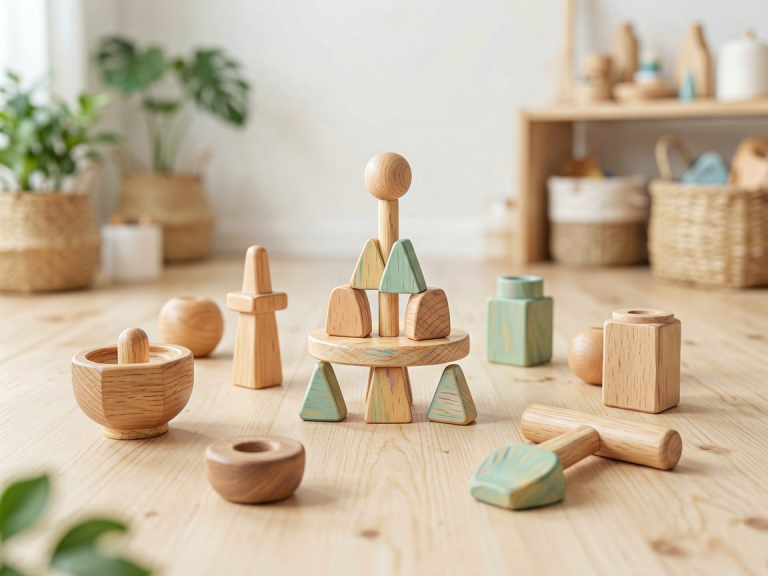
Traditional STEM kits often come with specific, limited parts. A “gear set” only works one way. In contrast, open-ended building materials like wooden blocks, LEGO bricks (in bulk, without themed instructions), or even “loose parts” (bottle caps, fabric scraps, twigs, pebbles) allow infinite possibilities. Parents love that these materials are durable, last for years, and can be used by children of all ages.
What It Looks Like
Dump a bin of mixed blocks on the floor and give a challenge: “Build a bridge that can hold this book,” or “Make a structure that is taller than your knee and can survive a gentle earthquake (shake the table).” Using loose parts, ask your child to design a marble maze on a cookie sheet, using clay walls and paper tunnels. The only rule: there is no right answer.
Deeper Learning
Open-ended building develops spatial reasoning, physics intuition (balance, symmetry, weight distribution), and early engineering design thinking. It also fosters creativity because children must invent their own problems to solve. Parents can encourage reflection: “What made your tower fall? How can you make the base wider?” This kind of play is the foundation of real innovation—unlike a kit, which tells you exactly where to put each piece.
—
5. Unplugged Coding – Logic Games Without Screens
Why Parents Approve
Many parents worry about screen time, yet want their children to learn computational thinking. Unplugged coding offers the best of both worlds: no batteries, no apps, no passive consumption. Parents approve because these activities are active, social, and often hilarious.
What It Looks Like
Create a “coding grid” on the floor using masking tape (a 4×4 or 5×5 grid). Place a “robot” (your child) in one square. Write a simple sequence of commands on cards (move forward, turn left, turn right, repeat). Have another child or a parent act as the “programmer” who hands the cards to the robot. The robot must follow the commands exactly. Then give a goal: “Get the robot to the red square.” Debug together when the robot crashes into a wall. Alternatively, use graph paper and markers to draw mazes and write arrow-based code.
Deeper Learning
Unplugged coding teaches sequencing, loops, conditionals, and debugging—core concepts of computer science. It also builds communication and teamwork. Parents can extend the activity by introducing “if-then” rules: “If you are in a blue square, skip the next instruction.” No screen, no login, no subscription—just pure logic and laughter.
—
Conclusion: The Real STEM Kit Lives in the Home
The best STEM education does not come shrink-wrapped in plastic. It comes from a cardboard box, a bag of baking soda, a pile of pebbles, and a parent who says, “I don’t know—let’s find out together.” Parent-approved alternatives to commercial STEM kits are not just cheaper; they are pedagogically superior. They honor the messy, iterative nature of real discovery. They teach children that science is not about following instructions perfectly—it is about asking good questions, making mistakes, and trying again.
The next time you are tempted to buy a shiny kit, look around your home. The kitchen, the recycle bin, the backyard, and a handful of wooden blocks already contain everything your child needs to become a scientist, an engineer, and a creative problem-solver. And you, the parent, get to be the co-explorer—not the instructor who reads from a manual. That is a win for everyone.