Beyond the Box: The Best Alternatives to Engineering Kits for Kindergarteners
Introduction: Why Look Beyond Pre-Packaged Kits?
Walk into any toy store or browse an online educational catalog, and you will be bombarded with brightly colored engineering kits promising to turn your kindergartener into the next great inventor. These kits often come with step-by-step instructions, predetermined pieces, and a single correct outcome—a plastic rob
The truth is, while engineering kits have their place, they often stifle the very creativity and problem-solving instincts that early childhood education should nurture. For kindergarteners, the best engineering experiences are not about following instructions but about exploring, testing, failing, and trying again. This is where alternative, open-ended materials shine. They are cheaper, more flexible, and far more conducive to developing the engineering mindset—curiosity, persistence, and the ability to see a problem from multiple angles.
In this article, I will explore the best alternatives to traditional engineering kits for kindergarteners. These alternatives are not only more cost-effective but also align with how young children naturally learn: through hands-on, sensory-rich, and child-directed play. Whether you are a parent, a teacher, or a caregiver, these substitutes will help your little learners build the foundational skills of an engineer without the limitations of a pre-packaged box.
1. Loose Parts: The Ultimate Open-Ended Engineering Resource
The concept of “loose parts” is hardly new, but it remains one of the most powerful alternatives to engineering kits. Loose parts are any collection of found, natural, or manufactured objects that children can combine, rearrange, and transform. Think of bottle caps, wooden spools, fabric scraps, corks, pebbles, buttons, and lengths of string. Unlike an engineering kit, which dictates exactly how each piece should be used, loose parts invite endless possibilities.
When a kindergarten child is given a bin of loose parts, they become an engineer, a designer, and a problem-solver all at once. They might build a tower using wine corks and flat stones, discovering that stability requires a wide base. They might create a simple machine—a lever—using a ruler and a small block. The cognitive load is higher because the child must decide the function of each part. There is no picture on a box telling them what to build. This type of open-ended play directly supports the engineering design process: ask, imagine, plan, create, and improve.
Moreover, loose parts are incredibly inclusive. They do not require fine motor skills as refined as those needed for tiny plastic gears, and they can be adapted for children with different abilities. A child who struggles with precision can still stack large corks or wrap yarn around a dowel. The sensory experience is rich—textures, weights, sounds—which deepens learning. If you want to foster true engineering thinking, fill a shelf with loose parts and watch your kindergartener’s imagination engineer a world.
2. Building Blocks: The Timeless Foundation of Structural Thinking
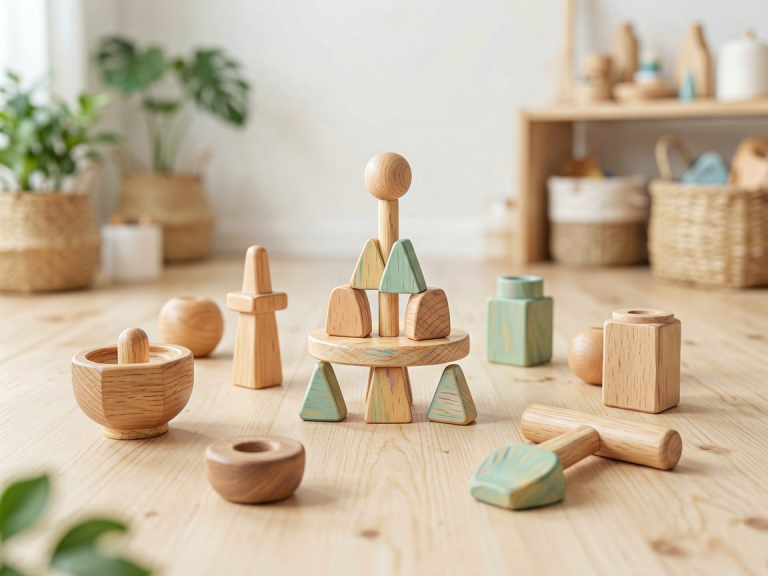
The humble building block is perhaps the oldest engineering toy known to humanity, and it remains unmatched in its educational value. However, when we talk about alternatives to engineering kits, we are not talking about the modern, themed Lego sets that come with a picture-perfect fire station or castle. Instead, we are talking about unit blocks—simple wooden blocks of various shapes and sizes, often with no pre-printed designs.
Unit blocks are the quintessential open-ended building material. They allow a kindergartener to experiment with balance, gravity, weight distribution, and symmetry. When a child builds a bridge with two blocks and a plank, they are intuitively learning about span and support. When they try to build a tall tower and it falls, they learn about center of gravity. These are the same principles that civil engineers study in university, but here they are discovered through play.
One of the best aspects of unit blocks is their scalability. With a large set, multiple children can collaborate, learning to communicate their ideas, negotiate space, and share resources—all essential engineering teamwork skills. Unlike an engineering kit where each piece has a specific role, a single block can be a wall, a pillar, a ramp, or a stepping stone. This flexibility encourages flexible thinking, a hallmark of innovative engineering.
For parents worried about the “mess” of blocks, consider that cleanup itself can be a mathematical and spatial exercise. Children learn to sort blocks by shape and size, and they begin to understand how objects fit into a designated space. Block play is so powerful that many early childhood experts consider it a non-negotiable part of a kindergarten classroom. It is a far richer alternative to most commercial engineering kits.
3. Recycled and Household Materials: Engineering from the Real World
One of the most accessible and environmentally friendly alternatives to engineering kits is the treasure trove sitting in your recycling bin. Cardboard boxes, paper towel rolls, plastic containers, yogurt cups, bottle caps, and egg cartons can all become parts of an engineering project. Not only are these materials free, but they also teach children an important lesson: engineering doesn't require special, expensive equipment; it requires resourcefulness.
With a roll of masking tape and a collection of recycled items, a kindergartener can build a marble run, a catapult, a simple pulley system, or even a cardboard castle with drawbridge. The act of cutting, taping, and assembling these materials develops fine motor skills and spatial reasoning. But more importantly, it introduces the concept of functional design. A child who wants to make a ramp for a toy car must consider the angle of the cardboard, the friction of the surface, and the weight of the car. They run experiments: “What happens if I make the ramp steeper?” “What if I tape two boxes together for a longer track?” This is the scientific method in action.
Furthermore, using recycled materials encourages children to see engineering potential in everyday objects. That empty tissue box is not just trash; it is a possible foundation for a robot head or a small bridge pier. This mindset—seeing possibilities in the ordinary—is what drives innovation. Many famous engineers and inventors started by tinkering with household junk. By providing your kindergartener with a “maker box” of recycled treasures, you are giving them the same fertile ground for creativity.
A word of caution: Always supervise younger children with tape and scissors, and avoid sharp edges. With that in mind, this alternative is unbeatable in fostering problem-solving, perseverance, and creative reuse.
4. Nature's Engineering Lab: Sticks, Stones, and Sand
Before there were plastic gears and metal bolts, children built with nature. And nature remains one of the best engineering laboratories for kindergarteners. A walk in the woods or a trip to the beach can provide all the materials needed for a rich engineering experience. Sticks become beams for a lean-to, stones become foundations for a dam, and sand becomes the medium for canals and tunnels.
Take sand play, for example. When a child builds a sandcastle, they are instinctively figuring out the optimal ratio of sand to water to achieve stability. They dig moats, build walls, and create bridges, all while learning about erosion, weight distribution, and structural integrity. Similarly, building with sticks requires understanding of leverage, friction, and balance. A simple task like making a stick figure stand upright involves trial and error, and the child must adjust angles and lengths constantly.
Nature-based engineering also connects children to the world around them. They learn about materials that are strong but flexible (green twigs), heavy but compressible (stones), and fine-grained but cohesive (wet sand). This sensory knowledge is foundational for later, more abstract scientific concepts. Moreover, working outdoors promotes physical activity and emotional well-being.
One particularly engaging nature-based engineering activity is building a “bug hotel” or a small shelter for a toy animal. This requires planning, gathering materials, and constructing a stable structure. The process is entirely child-driven, and the result is unique. Unlike an engineering kit where the final product is predetermined, a nature-built structure reflects the child’s own ideas and adaptations. There is no “wrong” way to build a shelter, as long as it stands. This freedom encourages risk-taking and creative solutions—exactly what budding engineers need.
5. Magnetic Tiles and Simple Mechanisms: The Low-Tech Middle Ground
While I have emphasized the value of non-commercial materials, I would be remiss not to mention one commercial product that stands out as a superior alternative to traditional engineering kits: magnetic building tiles (such as Magna-Tiles or Picasso Tiles). These are not kits in the traditional sense; they are open-ended construction sets that rely on magnetic connections rather than snap-fit or screw mechanisms.
Magnetic tiles are particularly well-suited to kindergarteners because they remove some of the frustration of balance while still requiring engineering thinking. The magnets hold the pieces together, allowing children to build 3D structures that would be impossible with loose blocks. They can create cubes, pyramids, bridges, and even simple machines like a seesaw by stacking tiles on a pivot point. The translucent, colorful nature of the tiles also introduces concepts of light and color mixing when held up to a window.
The genius of magnetic tiles is that they offer a low barrier to entry but a high ceiling for complexity. A two-year-old can connect two squares, while a five-year-old can build a multi-story building with a ramp inside. They encourage geometric reasoning and symmetry. Moreover, because the pieces are uniform and durable, they are easy to clean and store.
However, even here, I advise using magnetic tiles as a supplement rather than a replacement for the more open-ended materials listed above. Combine them with loose parts—place a small toy figure inside the magnetic cube, or use a cardboard ramp to roll a ball into a magnetic tunnel. This hybrid approach gives children the benefits of both structure and freedom.
Conclusion: The Engineer’s Mindset, Not the Engineer’s Kit
At the end of the day, the best alternative to any engineering kit is not a specific product but a philosophy. Engineering for kindergarteners should be about process, not product. It should celebrate the joy of experimentation, the thrill of solving a problem, and the resilience that comes from a structure crashing down. When we replace rigid kits with loose parts, blocks, recycled materials, nature, and thoughtful open-ended toys, we are not just saving money—we are nurturing the very qualities that make great engineers: creativity, persistence, and a willingness to see the world as a set of problems waiting to be solved.
So the next time you consider buying a shiny new engineering kit, pause. Instead, fill a box with bottle caps, take a walk to collect sticks and stones, or simply hand your child a stack of cardboard and a roll of tape. You might be surprised at what they build—and even more surprised at how much they learn.