Beyond the Blueprint: The Best Alternatives to Engineering Kits for 2-Year-Olds
Introduction: Rethinking Play for the Toddler Engineer
At two years old, a child’s brain is a whirlwind of discovery. Every dropped spoon, every overturned container, every squish of playdough is a lesson in physics, cause and effect, and spatial reasoning. It is no wonder that parents, eager to nurture this budding curiosity, often turn to “engineering kits” – colorful boxes promising to turn their toddler into a mini architect or mechanic. Yet, for a child who still puts almost everything in their mouth, who lacks the fine motor control for small screws, and whose attention span flits like a butterfly, most commercial engineering kits are frustratingly inappropriate. They often contain choking hazards, require adult-heavy supervision that stifles independent exploration, and, most critically, impose a predetermined outcome on a brain that learns best through open-ended experimentation.
The real building blocks of toddler engineering are not plastic gears and tiny bolts; they are the raw materials of the world around them. This article explores the best alternatives to engineering kits for two-year-olds—alternatives that honor a child’s natural developmental stage while laying a robust foundation for problem-solving, creativity, and the kind of deep, joyful learning that no instruction manual can provide. These alternatives are safer, more adaptable, and far more effective at nurturing the engineer inside every toddler.
Why Traditional Engineering Kits Fail the Two-Year-Old
Before diving into the alternatives, it is important to understand the specific pitfalls of engineering kits marketed for this age group. Most “toddler engineering sets” promise early STEM (Science, Technology, Engineering, and Mathematics) benefits, but they often miss the mark in three critical ways:
- Safety and Developmental Mismatch
Many kits include small pieces that are choking hazards. Even those labeled for ages 2+ often contain parts smaller than the recommended 1.25-inch diameter. Moreover, a two-year-old’s fine motor control is still developing—they can grasp and stack, but they struggle with precise alignment, twisting, or inserting tiny pegs. Frustration often replaces curiosity.
- Closed-Ended Play
Most engineering kits come with a specific goal: build a car, a tower, a windmill. For a toddler, the joy is in the process, not the product. A kit that demands a specific outcome can actually inhibit creativity. The child who wants to stack blocks sideways or use a gear as a pretend cookie is “using it wrong.” This rigidity undermines the exploratory mindset that engineering truly requires.
- Adult-Dependency
Complex instructions, fragile pieces, or the need for constant adult intervention can turn playtime into a teaching session. While guided play has its place, toddlers need long stretches of self-directed play to develop persistence and problem-solving skills. An engineering kit that demands adult help every five minutes interrupts that critical flow.
Top Alternatives: Building Brains without Blueprints
The following alternatives are not just “safe” versions of engineering kits—they are superior tools for cognitive and motor development. Each category encourages the same foundational skills (balance, cause and effect, spatial awareness, creativity) but does so in a way that respects a two-year-old’s unique way of learning.
1. Open-Ended Wooden Blocks: The Timeless Engineer’s Best Friend
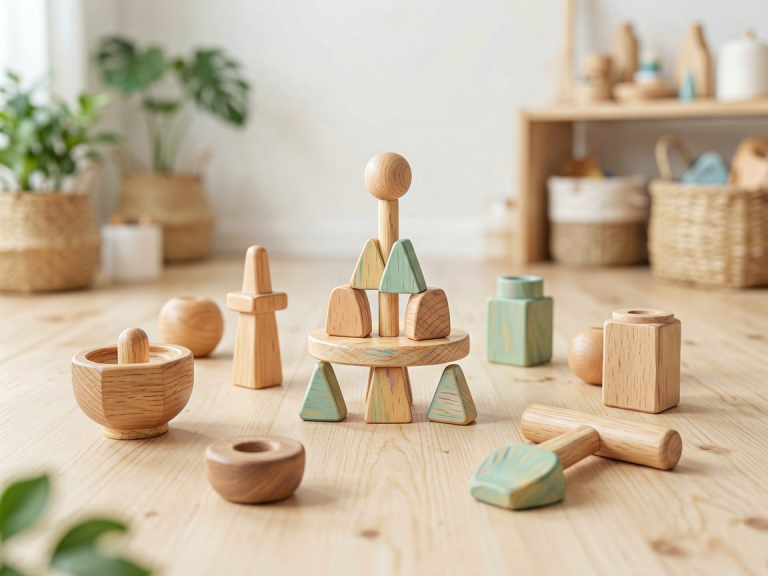
No alternative surpasses the humble set of wooden unit blocks. Unlike plastic kits with connectors and wheels, wooden blocks are simple, tactile, and infinitely versatile. A two-year-old can stack them, knock them down, line them up, or use them as pretend food. The lack of predefined shapes (beyond rectangles, triangles, and cylinders) forces the child to experiment with weight distribution, balance, and symmetry.
- Why it works: Wooden blocks require no instructions. A child discovers that a tall tower is unstable unless the base is wide. They learn that a block placed half-off the stack will fall. These are pure physics lessons, learned through trial and error. Moreover, the blocks’ weight provides proprioceptive feedback—the child feels gravity working—unlike lightweight plastic pieces that do not convey the same physical truth.
- Specific recommendation: A set of 40–60 unpainted, solid hardwood blocks in standard unit sizes (e.g., 1×1, 2×1, 4×1). Avoid sets with painted letters or numbers, as they distract from pure building.
- Extensions: Add a cardboard ramp, a small basket of toy animals, or fabric scarves to transform the blocks into bridges, barns, or roads.
2. Magnetic Tiles: The Gateway to Structural Thinking
Magnetic tiles (like Magna-Tiles or PicassoTiles) have become a modern classic for good reason. Unlike classic blocks, they attach via magnets embedded in the edges, enabling children to build structures that defy gravity in ways blocks cannot—such as cubes that can be effortlessly flipped, roofs that stay put, and enclosures that don’t collapse.
- Why it works: For a two-year-old, the magnetic “click” provides immediate, satisfying feedback. They can create 3D forms without the frustration of balancing. This builds an intuitive understanding of geometry and spatial relationships. Because the tiles are translucent and colorful, they also stimulate visual exploration—a child might hold a tile up to the light or look through it at the world, adding a sensory dimension.
- Safety note: Ensure the tiles are large (at least 2.5 inches square) and have sealed edges to prevent magnet exposure. Avoid cheap knock-offs with weak magnets that may break.
- Play ideas: Build a “house” for a stuffed animal, create a flat pattern on the floor and then lift it into a 3D shape, or simply stack them arbitrarily. The open-ended nature encourages endless variation.
3. Loose Parts from Nature and the Home
The concept of “loose parts” — first articulated by architect Simon Nicholson — holds that the more movable, open-ended materials children have, the more creative their play. For a two-year-old, the best loose parts are large, safe, and varied in texture, weight, and shape.
- Natural materials: Pinecones, large smooth stones, acorns (with adult supervision to avoid choking), sticks of equal length, dried leaves, and chunks of bark. These materials are irregular, imperfect, and full of sensory information. A child can sort them, line them up, stack them, or use them as “ingredients” for imaginary soup.
- Household items: Cardboard tubes (from wrapping paper or paper towels), clean plastic yogurt cups, different-sized lids, fabric scraps, wooden spoons, and silicone muffin cups. A simple cardboard box becomes a house, a vehicle, or a fort.
- Why it works: Loose parts invite the child to be the engineer of their own experience. They decide whether a pinecone is a tree, a wheel, or a hat. There is no right or wrong. This type of play builds executive function—planning, decision-making, and flexible thinking—far more effectively than a kit with a single purpose.
- Practical tip: Offer loose parts in a low tray or basket, and rotate them weekly to maintain novelty. Always inspect for splinters or sharp edges.
4. Simple Building Supplies: Tape, Cardboard, and Connectors
Two-year-olds love connecting things. Instead of a kit with plastic fasteners, offer real-world joining materials that require problem-solving.
- Painter’s tape and cardboard: Show your child how to tape two cardboard tubes together to make a long tunnel. They can tape a paper plate to a box to make a roof. The tape is easy to tear by hand (no scissors needed for the adult), and it sticks well but removes easily from most surfaces.
- Pool noodles and straws: Cut pool noodles into 4-inch lengths. A child can “build” by stacking them, or you can poke holes in a cardboard box and let them insert the noodle pieces like pegs. Large plastic straws can be threaded onto a shoelace to make a necklace or a chain.
- Why it works: These materials are malleable and forgiving. A child learns that tape holds two objects together, but if they place it poorly, it falls apart. This is real engineering feedback. The physical act of pressing tape, pushing a straw through a hole, or bending a pipe cleaner hones fine motor muscles far more than manipulating tiny plastic screws.
5. Sensory Bins with a Construction Theme
A sensory bin filled with materials that mimic engineering environments can captivate a two-year-old for hours, all without a single instruction sheet.
- Recipe: Use a shallow plastic tub filled with dry rice, sand, or chickpeas as the base. Add safe “building” elements: large plastic scoops, small cardboard blocks, toy dump trucks, and rocks. Add scoops and containers for pouring and measuring.
- Why it works: Engineering is not just about static structures; it is about moving materials, measuring, and transforming. In a sensory bin, the child becomes a construction worker, digging, pouring, and hauling. They are learning principles of volume, weight, and motion. The sensory input (textures, sounds, even smells) strengthens neural connections.
- Safety: Always supervise with dry beans or rice, as some children may still mouth them. Opt for large items like pasta shells or water as the base if needed.
How to Choose the Right Alternative for Your Child
Not every alternative works for every toddler. Consider your child’s temperament and current skills:
- The “Purist” Stacker: If they love putting things on top of each other and knocking them down, go with wooden blocks.
- The “Connector”: If they are fascinated by clicking and attaching, magnetic tiles or pool-noodle pegs will delight them.
- The “Sensory Seeker”: If they love to touch, scoop, and move, a loose-parts bin or a construction-themed sensory bin is ideal.
- The “Role-Player”: If they mimic adult activities (cooking, driving, building), offer household items like cardboard tools (a paper towel tube as a wrench) and let them “fix” things.
Rotate the materials every few days. A two-year-old thrives on novelty, but too many options at once can overwhelm. Start with two or three alternatives and observe what captures their attention.
Conclusion: The Real Engineer’s Mindset
The best alternative to an engineering kit is not a better product—it is a better philosophy. At two years old, a child does not need a kit that teaches them “how to build a bridge.” They need the freedom to discover what a bridge is, why it stands, and what happens when it falls. They need materials that respond to their actions unpredictably because that unpredictability is where learning lives.
Wooden blocks, magnetic tiles, loose parts from nature, tape and cardboard, and sensory bins all share one essential quality: they place the child in the role of creator, not consumer. They invite questions: “What happens if I put this heavy block on top of that thin one?” “Can I make the car go down the ramp faster?” “How many pinecones fit in this cup?” These are the authentic beginnings of engineering—not a set of instructions, but a set of possibilities.
So the next time you are tempted by a glossy box labeled “My First Engineering Kit,” remember that the most powerful engineering tool for a two-year-old is the open, curious, trusting environment you provide. Hand your child a cardboard tube and a ball of tape, sit back, and watch the engineer emerge. The bridge they build might be wobbly, the tower might topple, but the mind they are constructing will be strong enough to last a lifetime.