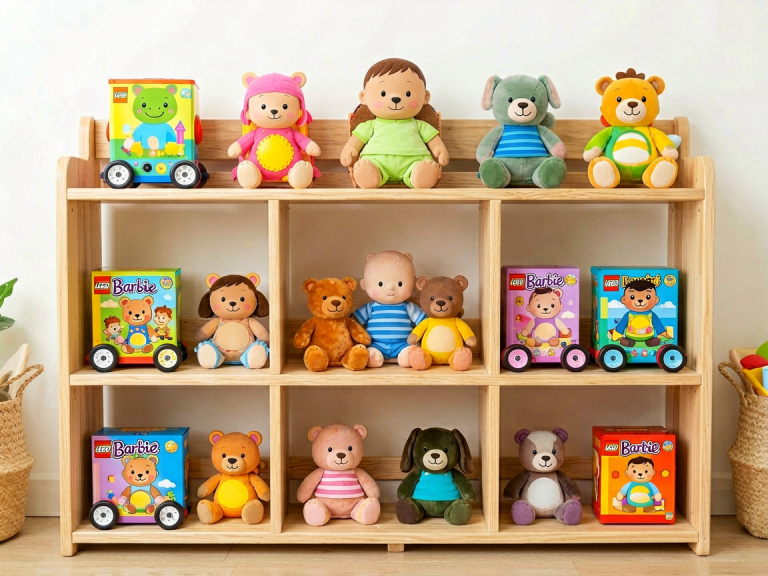
The Unplugged Playground: Exploring the Pros and Cons of Screen-Free Toys
—
Introduction
In an era where children’s lives are increasingly mediated by glowing rectangles—tablets, smartphones, and televisions—the humble screen-free toy has emerged as a quiet counterweight. From wooden blocks and stuffed animals to board games and jigsaw puzzles, these analogue objects have been the backbone of childhood for centuries. Yet the digital revolution has cast them in a new light: are they relics of a simpler time, or essential tools for healthy development? The debate over screen-free toys is not just about entertainment; it touches on cognitive growth, social skills, environmental impact, and even parental convenience. To understand their true value, we must examine both their benefits and their drawbacks, acknowledging that the absence of a screen does not automatically make a toy superior.
—
The Case for Screen-Free Toys: Why Going Analogue Matters
1. Fostering Unstructured Creativity and Imagination
One of the most celebrated virtues of screen-free toys is their ability to ignite unstructured play. Unlike a digital game that presents pre-programmed scenarios and win conditions, a set of plain wooden blocks invites a child to build anything—a castle, a spaceship, a tower that will inevitably topple. This open-endedness is crucial for cognitive development. According to child psychologists, when children engage with toys that have no fixed purpose, they exercise divergent thinking, the ability to generate multiple solutions to a problem. For example, a simple doll can become a doctor, a teacher, a superhero, or a frightened child in a single afternoon. These imaginative leaps are harder to achieve with a screen-based toy that dictates the narrative. Screen-free toys thus serve as blank canvases for the mind, encouraging children to write their own stories rather than consume someone else’s.
2. Enhancing Fine Motor Skills and Physical Engagement
Many screen-free toys require tangible manipulation that strengthens small muscle groups. Building with LEGO bricks, threading beads, cutting with safety scissors, or arranging puzzle pieces all demand precise hand-eye coordination and finger dexterity. In contrast, swiping a touchscreen involves relatively coarse movements. Occupational therapists consistently recommend hands-on toys for developing the pincer grip necessary for later writing skills. Moreover, screen-free toys often involve larger physical movements. A tricycle, a skipping rope, or a set of balance beams gets children moving, combating the sedentary lifestyle that screens promote. The kinesthetic feedback—the texture of wood, the weight of a marble, the resistance of clay—also enriches sensory integration, which is vital for children with sensory processing differences.
3. Promoting Social Interaction and Emotional Intelligence
When two children play with screen-free toys—say, a board game or a set of building bricks—they must negotiate, share, take turns, and read each other’s facial expressions. These interactions are the foundation of emotional intelligence. Digital platforms, even when “multiplayer,” often reduce communication to typed messages or emojis, stripping away the nuance of body language. A child who builds a fort with a friend learns to compromise (“You put the red block here, and I’ll put the blue one there”) and to cope with frustration when the structure collapses. Studies have shown that children who engage in regular cooperative analogue play demonstrate higher empathy and conflict-resolution skills. Furthermore, screen-free toys can be inclusive: a child with limited literacy can still play a memory card game or build with magnetic tiles, whereas many digital games require reading or complex navigation.
4. Reducing Overstimulation and Encouraging Focus
Screens are designed to capture attention through rapid scene changes, bright colors, and reward loops—a strategy that often leads to overstimulation and shortened attention spans. Screen-free toys, by contrast, operate at a slower pace. A jigsaw puzzle demands sustained concentration; a marble run requires patient trial and error. This slower rhythm allows the brain to enter a state of “flow,” where deep learning occurs. Pediatricians warn that excessive screen time can disrupt sleep patterns and increase anxiety by flooding young brains with dopamine spikes. Screen-free toys provide a calmer alternative, allowing children to regulate their own arousal levels. They also offer a sanctuary for downtime, which is increasingly scarce in a world of constant notifications.
5. Environmental and Economic Benefits
Many screen-free toys are built to last. A wooden train set from the 1970s can still be played with today, while a tablet becomes obsolete in three years. The durability of non-digital toys reduces electronic waste and the demand for rare minerals used in circuit boards. Additionally, screen-free toys are often more affordable; a deck of cards costs a fraction of a new video game, and a second-hand dollhouse can be passed down through generations. Parents can also foster creativity by making toys from household items—cardboard boxes, fabric scraps, bottle caps—teaching resourcefulness and minimizing consumerism. In an age of disposable tech, the longevity of analogue toys offers both financial and ecological relief.
—
The Flaws in Analogue: Challenges and Limitations of Screen-Free Toys
1. Limited Access to Educational Content and Adaptive Learning
One of the most significant drawbacks of screen-free toys is their inability to adapt to a child’s individual learning level. Digital educational apps can use algorithms to adjust difficulty in real time: if a child struggles with fractions, the app offers more practice; if they excel, it presents harder challenges. A traditional multiplication flashcard set cannot do that. Screen-based learning tools also provide instant feedback and can incorporate multimedia—videos, animations, sound effects—that make abstract concepts tangible. For example, an app that simulates the solar system allows a child to zoom into planets and watch their orbits, whereas a plastic model of the solar system is static. While hands-on learning is valuable, it sometimes falls short when teaching complex, layered subjects like coding, foreign languages, or advanced mathematics.
2. Lack of Digital Literacy and Tech Preparedness
We live in a digital world, and children must learn to navigate it safely and effectively. Screen-free toys, by their very nature, do not teach keyboarding skills, online safety, or how to evaluate digital information. A child who has only played with wooden puzzles may struggle when faced with a computer-based test in school. Moreover, many future jobs will require proficiency in software, data analysis, and communication via digital platforms. While a foundation of creativity and problem-solving is essential, so is familiarity with technology. Some argue that delaying screen exposure until later years can put children at a disadvantage compared to peers who started using educational apps in preschool. The key is balance, but screen-free purists risk ignoring an important aspect of modern education.
3. Space Constraints and Clutter
Screen-free toys tend to be bulky. A dollhouse, a large set of building bricks, a train table, or a collection of board games takes up considerable physical space—often a scarce resource in modern apartments. Screens, on the other hand, store thousands of games and activities in a single device. Parents may find themselves overwhelmed by the clutter of toy bins, tripping over blocks and stepping on LEGO pieces. Organization becomes a chore, and the novelty of a toy can fade quickly, leading to piles of unused items. Digital toys suffer from their own form of clutter (orphaned apps, forgotten accounts), but the physical mess is avoided. For families who value minimalism or live in small homes, the bulk of screen-free toys can be a genuine burden.
4. Lower Engagement and Motivation for Some Children
Not all children thrive on open-ended analogue play. Some are naturally drawn to the structure, visual stimulation, and rewards of digital games. A child with ADHD, for example, may find a jigsaw puzzle frustratingly slow and lose focus quickly, whereas a fast-paced puzzle app with positive reinforcement might hold their attention long enough to develop cognitive skills. Similarly, children who are reluctant readers may be more willing to engage with a story through an interactive e-book. Screen-free toys rely heavily on a child’s intrinsic motivation to play, and when that motivation is low, the toys gather dust. Digital toys can provide external motivation through points, levels, and animations, which, while criticized for fostering addiction, can also be a gateway to learning for disinterested learners.
5. Reduced Independence for Parents and Caregivers
One of the unspoken reasons parents embrace screens is the respite they offer. A tablet can occupy a child on a long car ride, in a waiting room, or during a parental work call. Screen-free toys often require more active supervision—especially with young children who might swallow small parts or hurt themselves with sharp edges. A caregiver cannot simply hand a child a box of wooden blocks and expect an hour of quiet solitude; there will be requests for help, moments of frustration, and the inevitable mess. In contrast, a well-designed educational app can provide an engaging, self-directed experience that frees up adult time. For overworked parents, the convenience of screens is a tangible advantage that screen-free advocates sometimes underestimate.
6. Potential for Monotony and Limited Variety
Even the most imaginative child may eventually tire of the same set of blocks. Screen-free toys have finite play possibilities unless a parent constantly introduces new materials or rotates toys—a process that demands time, money, and storage. Digital libraries, however, offer immense variety at the tap of a finger: one day a child can color, the next day solve a maze, the next day listen to a symphony, all without consuming physical space. Variety is known to stimulate curiosity and prevent boredom, which is a double-edged sword. While too much variety on screens can lead to constant switching and shallow engagement, the absence of novelty in analogue toys can also lead to complacency. Parents must actively curate the toy environment to keep it fresh, an effort that not everyone can sustain.
—
Conclusion: Finding the Middle Ground
The debate between screen-free and screen-based toys is not a binary war but a nuanced spectrum. Screen-free toys excel at fostering creativity, motor skills, social interaction, and calm focus, while also being environmentally friendly and durable. Yet they are not a panacea: they can be limited in educational adaptability, fail to teach digital literacy, consume physical space, and sometimes fail to engage children who need more structure or motivation. The healthiest childhood environment likely includes a thoughtful mix of both. Parents should prioritize screen-free toys for free play, especially in early years, while selectively introducing high-quality digital tools that complement—not replace—hands-on experiences. The goal is not to demonize screens but to ensure they serve as tools rather than babysitters. In the end, the best toy is one that sparks curiosity, builds skills, and brings joy—whether it is covered in pixels or carved from wood.