The Complete Age-Appropriate Play Guide for Parents: Nurturing Development Through Every Stage
Introduction: Why Age Matters in Play
Play is the language of childhood. It is not merely a way to pass the time; it is the primary mechanism through which children explore the world, build cognitive skills, develop social competence, and strengthen emotional resilience. However, not all play is created equal. A toy that delights a three-year-old may frustrate a one-year-old, and a game that challenges a seven-year-old may bore a ten-year-old. As parents, understanding what constitutes age-appropriate play is essential—not only to keep children safe but also to maximize the developmental benefits of every minute they spend engaging in play. This guide offers a comprehensive roadmap, breaking down the key milestones and recommended play activities for children from infancy through the early school years, backed by child development research and practical advice.
—
Section 1: Infants (0–12 Months) – Sensory Exploration and Bonding
1.1 Developmental Priorities in the First Year
During the first twelve months, an infant’s brain doubles in size, and neural connections are forming at an astonishing rate. At this stage, play is primarily about sensory stimulation: touching, hearing, seeing, tasting, and smelling. Babies are also developing trust and attachment through responsive interactions with caregivers. Age-appropriate play for infants should focus on safety, simplicity, and the quality of human interaction.
1.2 Recommended Play Activities
- Tummy Time (0–6 months): Lay your baby on a firm, flat surface on their stomach for short periods (starting with 1–2 minutes, gradually increasing). Use a mirror or a black-and-white contrast card in front of them to encourage head lifting and visual tracking. This strengthens neck, shoulder, and arm muscles, laying the foundation for crawling.
- Rattles and Soft Textures (3–9 months): Offer lightweight rattles, crinkle cloths, or soft plush toys with various textures. Babies will bring these to their mouths (mouthing is a key form of exploration), so ensure all items are BPA-free, non-toxic, and have no small parts that could become choking hazards.
- Peek-a-Boo and Face-to-Face Play (4–12 months): Simple games like peek-a-boo teach object permanence—the understanding that something exists even when it is out of sight. Hold a soft cloth over your face, then reveal yourself with a cheerful “Peek-a-boo!” Your baby’s laughter is not just joy; it is a sign that their brain is making crucial cognitive connections.
- High-Contrast Books and Mobiles (0–6 months): Newborns see best in black, white, and red. Use hanging mobiles with high-contrast patterns or board books with large, simple images. As they grow, introduce books with bright colors and single objects per page.
1.3 Safety and Supervision Notes
Never leave an infant unsupervised with any toy, especially during tummy time. Check for sharp edges, loose strings, or detachable parts. Rotate toys every few days to maintain novelty without overwhelming the child. Remember that the most important “toy” for an infant is your face, your voice, and your touch.
—
Section 2: Toddlers (1–3 Years) – Movement, Imitation, and Language Explosion
2.1 The Rapidly Changing Toddler Brain
Toddlers are on the move. They are learning to walk, run, climb, and manipulate objects with increasing precision. Language explodes from a handful of words to short sentences. They are also beginning to imitate adult behaviors—pushing a toy vacuum, talking on a play phone—and this imitation is a vital part of social and cognitive development. Play for this age group should encourage gross motor skills, fine motor coordination, and early pretend play, all while being sturdy and safe enough to withstand enthusiastic handling.
2.2 Recommended Play Activities
- Push-and-Pull Toys (12–24 months): A sturdy wooden push cart or a string-pull toy (like a wooden animal on wheels) helps develop walking balance and spatial awareness. Look for toys with a low center of gravity to prevent tipping.
- Shape Sorters and Stacking Rings (12–24 months): These classic toys teach problem-solving, hand-eye coordination, and the concept of size and order. Choose chunky pieces that are easy to grasp. Avoid magnets or small pieces that could be swallowed.
- Simple Puzzles with Knobs (18–36 months): Puzzles with large, chunky pieces and a hole-punched knob in the center allow toddlers to practice matching shapes. This builds hand strength and visual discrimination.
- Pretend Play Starter Sets (24–36 months): A toy kitchen, a play tool bench, or a doll with simple clothing introduces the world of “let’s pretend.” This is the beginning of symbolic thinking, which lays the groundwork for later literacy and complex problem-solving.
- Ball Play (18–36 months): Rolling a large, soft ball back and forth teaches turn-taking and motor planning. As they grow, encourage them to throw underhand or kick a stationary ball.
2.3 Managing Common Challenges
Toddlers have short attention spans and may flit from one activity to another every few minutes. That is normal. Avoid forcing them to “finish” a puzzle; instead, let them lead. Also, be prepared for parallel play—toddlers often play side-by-side without interacting, which is a healthy stage before cooperative play emerges.
—
Section 3: Preschoolers (3–5 Years) – Imagination, Social Play, and Early Academics
3.1 The Golden Age of Make-Believe
Between the ages of three and five, children become masters of fantasy. They invent elaborate scenarios, assign roles to friends and toys, and construct worlds that follow their own rules. This imaginative play is critical for developing empathy, self-regulation, and narrative skills. At the same time, preschoolers are refining fine motor control (cutting, drawing, buttoning) and beginning to understand basic concepts like counting, letters, and colors. Age-appropriate play at this stage should balance open-ended creativity with structured opportunities to practice emerging academic skills.
3.2 Recommended Play Activities
- Dress-Up and Role-Play Costumes (3–5 years): Keep a bin of simple costumes—firefighter hats, doctor coats, fairy wings, and scarves. Children will spontaneously create stories, negotiate roles (“I’ll be the doctor, you be the patient”), and learn to cooperate. This type of play also supports language development as they narrate their actions.
- Building Blocks and Construction Sets (3–5 years): Large wooden blocks or interlocking plastic bricks (like Duplo) allow preschoolers to build towers, bridges, and cities. Construction play enhances spatial reasoning, planning, and fine motor skills. Challenge them with a simple goal: “Can you build a house with a door that opens?”
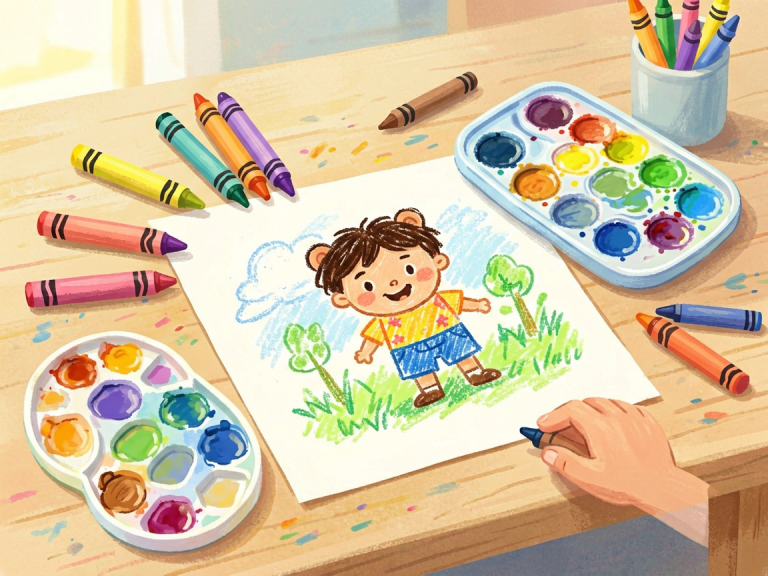
- Art and Craft Supplies (3–5 years): Provide washable markers, crayons, child-safe scissors, glue sticks, and a variety of paper. Encourage free drawing, but also try directed activities like cutting out shapes or tracing letters. The goal is not to create a perfect drawing but to develop hand strength and creative confidence.
- Board Games with Simple Rules (4–5 years): Games like “Candy Land,” “Chutes and Ladders,” or “Go Fish! (using picture cards) introduce turn-taking, counting, and following rules. Start with very short games (5–10 minutes) to match attention spans.
- Outdoor Play with Purpose (3–5 years): Climbing structures, tricycles, sandboxes, and water tables. Outdoor play helps with gross motor development, risk assessment, and sensory integration. Always supervise, especially near water or heights.
3.3 When to Encourage, When to Step Back
Preschoolers may become frustrated when their imagined story doesn’t align with reality. If children argue over roles, intervene only to model problem-solving (“What if you take turns being the superhero?”). Avoid over-structuring their play; the best learning often happens when children lead. Introduce early academics (letters, numbers, shapes) through playful songs, puzzles, and games, not through worksheets or drills.
—
Section 4: Early School-Age Children (5–8 Years) – Rules, Strategy, and Social Complexity
4.1 The Shift Toward Structured Play
By age five or six, children typically enter formal schooling, and their play begins to reflect a new understanding of rules, fairness, and teamwork. They can follow multi-step instructions, engage in longer cooperative play sessions, and develop specific interests—dinosaurs, dance, soccer, coding. At the same time, their physical abilities are growing: they can ride a bicycle, skip, catch a ball with coordination, and use tools with greater precision. Play for this age should challenge their reasoning skills, foster perseverance, and allow for both competitive and cooperative interactions.
4.2 Recommended Play Activities
- Complex Construction Kits (5–8 years): Transition from Duplo to smaller LEGO sets, or introduce K’NEX, magnetic tiles, or model-building kits. Following a set of instructions for a complex build teaches patience, sequencing, and spatial visualization. Free-building, however, should still be encouraged to nurture creativity.
- Strategy Board Games and Card Games (5–8 years): Games like “Checkers,” “Settlers of Catan: Junior,” “Uno,” or “Memory” require planning, memory, and critical thinking. These games also provide natural opportunities to practice winning and losing gracefully—a key emotional skill.
- Sports and Physical Games (5–8 years): Organized sports such as soccer, T-ball, or swimming lessons introduce teamwork, following coach instructions, and physical fitness. However, free play on the playground—climbing, swinging, and chasing—is equally important for developing body awareness and social negotiation.
- Reading-Based Play and Story Creation (5–8 years): Encourage children to write and illustrate their own stories, perform puppet shows, or act out scenes from books they love. This deepens reading comprehension and narrative skills. Try “secret message” games where they write simple coded notes to family members.
- Science and Nature Exploration (5–8 years): Give them a magnifying glass, a simple microscope, or a bug-catching kit. Plant seeds in a pot and track growth. Simple experiments (like mixing baking soda and vinegar) teach cause and effect and ignite curiosity.
4.3 Balancing Screen Time with Physical Play
Many children of this age become interested in digital games. Screen-based play should be high-quality (educational apps, creative software, or age-appropriate video games) and limited to no more than one to two hours per day of sedentary screen time, according to the American Academy of Pediatrics. Pair any digital activity with a discussion: “What did you learn from that game?” or “Can you draw a character from the story?”
—
Section 5: Tweens (8–12 Years) – Mastery, Hobbies, and Social Identity
5.1 The Emergence of Specialization
As children approach the tween years, play becomes more sophisticated. They often develop passionate interests in specific domains—music, sports, coding, crafting, collecting, or gaming. They are capable of sustained concentration for an hour or more and can engage in abstract reasoning, complex rule systems, and long-term projects. Social dynamics shift: friendships become more nuanced, and peer approval grows in importance. Play should allow for mastery, independent decision-making, and opportunities for both solo and group activities.
5.2 Recommended Play Activities
- Creative and Technical Outlets (8–12 years): Learn a musical instrument, take a pottery class, try basic woodworking, or learn to code with platforms like Scratch or Python (using beginner-friendly tutorials). These activities build discipline, self-esteem, and a sense of accomplishment.
- Advanced Game Systems (8–12 years): Strategy board games like “Risk,” “Catan,” “Ticket to Ride,” or “Dungeons & Dragons” (simplified) challenge planning, negotiation, and storytelling. Trading card games (e.g., Pokémon, Magic: The Gathering) involve strategy, math, and memory.
- Outdoor Adventures and Team Sports (8–12 years): Hiking, biking, rock climbing (with proper safety gear), and organized team sports become more competitive and rewarding. Emphasize sportsmanship and effort over winning.
- Research and Collection Projects (8–12 years): Encourage a deep dive into a topic—dinosaurs, space, ancient Egypt, or a favorite video game lore. Building a collection (rocks, coins, stamps, action figures) can teach organization, history, and patience.
- Social Play with Technology (8–12 years): If allowed, supervised online multiplayer games with voice chat on a shared family device can teach digital etiquette, collaboration, and problem-solving. Set clear time limits and discuss online safety regularly.
5.3 The Role of Parent as Coach, Not Director
At this stage, your role shifts from playmate to facilitator. Provide resources (instruments, sports equipment, books) and transportation, but let your child choose the direction. Avoid over-scheduling; tweenagers still need unstructured time to daydream, build forts, or just hang out with friends. That unstructured time is itself a form of play—self-directed and essential for developing autonomy.
—
Conclusion: The Timeless Value of Playful Parenting
Age-appropriate play is not a rigid checklist but a flexible guide that respects your child’s unique pace and personality. The toys and activities that captivate a two-year-old will evolve, but the underlying principles remain constant: safety, stimulation, social connection, and joy. As a parent, your most powerful tool is your presence—getting down on the floor, joining the imaginary tea party, or cheering from the sidelines. By choosing play that matches your child’s developmental stage, you are not only preventing frustration and boredom but also actively building the neural architecture that will support your child’s learning, relationships, and well-being for life. So turn off the screens when you can, open a cardboard box, and let the magic begin.
*(Word count: approximately 1,550 words)*