Building the Foundations of Curiosity: Science and Engineering Toys for One-Year-Olds
—
Introduction: Why Science and Engineering Matter at Twelve Months
At first glance, the idea of “science toys” or “engineering toys” for a one-year-old might seem laughable. After all, a twelve-month-old is still mastering the art of standing upright, uttering a few recognizable syllables, and understanding that objects continue to exist even when hidden under a blanket. Yet the first year of life is a period of explosive cognitive development. Neuroscience confirms that the infant brain forms more than one million new neural connections every second during the first few years. The play experiences a one-year-old has are not merely distractions—they are the raw material from which future understanding of cause, effect, structure, and systems will be built.
Science and engineering toys for this age group are not about teaching Newtonian physics or coding fundamentals. Instead, they are about sensory exploration, cause-and-effect relationships, spatial reasoning, and fine-motor skill development—all of which are the building blocks of scientific thinking. A toy that rolls when pushed teaches gravity and momentum. A set of stacking cups introduces concepts of volume, balance, and hierarchy. A block tower that wobbles and falls is a toddler’s first lesson in structural stability. In this article, we will explore the developmental rationale behind introducing science- and engineering-oriented playthings to one-year-olds, examine specific types of toys that serve these purposes, and provide practical guidelines for caregivers who want to nurture a budding little engineer or scientist.
—
The Developmental Landscape of a One-Year-Old
Sensory Integration and Physical Milestones
By twelve months, most infants are transitioning from crawling to walking, and their manual dexterity has improved dramatically. They can pick up small objects with a pincer grasp, transfer items from one hand to the other, and intentionally release objects—a skill that allows them to drop a toy just to watch it fall (much to the caregiver’s annoyance). This “dropping game” is actually a primitive form of scientific experimentation. The child is testing the consistency of gravity: will the ball always fall? Will it make the same sound on carpet as on tile? Science toys for this age must align with these emerging abilities. They should be lightweight, easy to grasp, and large enough to prevent choking (minimum 1.5 inches in diameter for spherical objects, according to CPSC guidelines). The toys should also be durable, washable, and free of small parts, batteries, or magnets that could be swallowed.
Cognitive Concepts Being Formed
At this stage, infants are developing what psychologists call “object permanence” (the understanding that things continue to exist even when out of sight), and they are beginning to recognize patterns. They are also experimenting with means-end relationships: “If I shake this rattle, it makes noise. If I push this car, it moves away.” This is the embryonic form of the scientific method—hypothesis, action, observation, conclusion. Engineering concepts also appear naturally. When a toddler tries to fit a shape into a hole, they are dealing with geometry and spatial constraints. When they stack blocks and the tower topples, they learn about center of gravity and load distribution. Therefore, the best “STEM” toys for one-year-olds are those that amplify these natural experiments, providing clear, predictable, and safe feedback.
—
Essential Categories of Science and Engineering Toys for One-Year-Olds
1. Cause-and-Effect Discovery Toys
Description: Any toy that produces a consistent, observable reaction to a specific action qualifies as a cause-and-effect toy. For one-year-olds, the action should be simple—a push, a shake, a squeeze, or a turn.
Examples:
- Activity cubes and busy boards with knobs, sliders, buttons that trigger sounds or pop-ups. These toys teach that a deliberate action (pressing a button) leads to a reliable outcome (a light flashes or a small door opens). The predictability reinforces the child’s sense of agency and control, a foundational aspect of scientific inquiry.
- Ball drop towers (where a ball is placed at the top of a ramp and rolls down through a series of levels, finally emerging at the bottom). At twelve months, a child may not be able to place the ball themselves, but they will watch intently as a caregiver demonstrates. Soon they will try to release the ball themselves, learning about gravity, momentum, and trajectories.
- Simple pop-up toys (like those with a push-button that causes a character to spring up). The sudden motion delights infants and reinforces the relationship between force and movement.
Why it works: Repetition is key. A one-year-old may drop the same block fifty times in a row, testing the same cause-and-effect loop. This is not boredom—it is data collection. Toys that provide clear, immediate, and repeatable feedback support this essential learning process.
2. Stacking, Nesting, and Balancing Sets
Description: These are the quintessential engineering toys for toddlers. They involve manipulating objects in three-dimensional space to achieve a configuration—usually a tower, a nested set, or a balanced structure.
Examples:
- Stacking rings (cone with graduated rings): The child must learn to place larger rings first or find the correct order. This teaches size ordering, fine-motor control, and the concept of base stability.
- Nesting cups: These can be stacked up or nested inside each other. They introduce volume (smaller fits inside larger), ordering, and the engineering principle of structural hierarchy. When a child attempts to stack cups upside-down, they learn that a wide base is more stable than a narrow one.
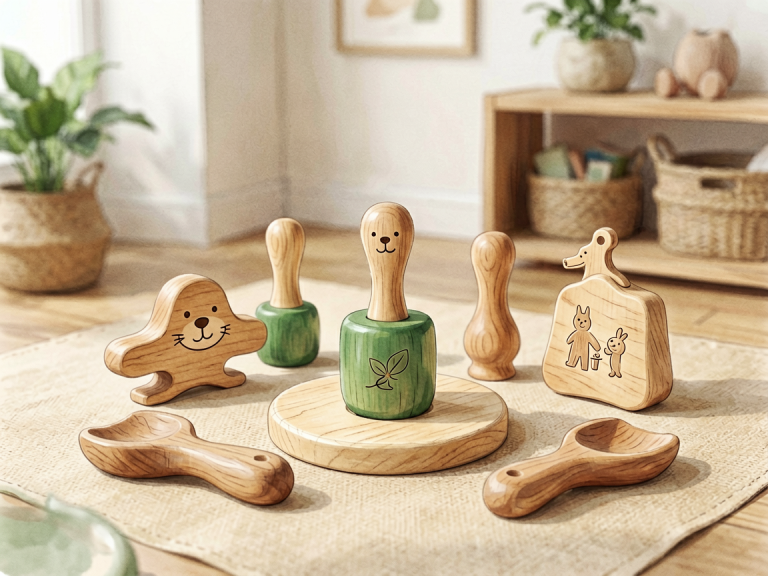
- Wooden block sets (with smooth edges): Simple wooden blocks in various shapes (cubes, cylinders, arches). A one-year-old may only be able to stack two or three blocks, but this is a triumph of engineering. They learn about alignment, gravity, and the frustration and joy of structural failure.
Why it works: These toys require spatial reasoning and balance. Every time a block falls, the child receives immediate feedback on the limits of stability. By adjusting the placement of the next block, they begin to intuit principles that will later be formalized as physics.
3. Water and Sand Play Equipment
Description: Water and sand are naturally science-rich media. They allow children to observe changes in state, flow, and displacement without needing complex mechanisms.
Examples:
- Waterproof floating toys (boats, ducks): A child learns that some objects float while others sink. They can pour water from one cup to another, observing how liquid takes the shape of its container—a fundamental property of matter.
- Sand molds and scoops: Scooping, dumping, and filling introduces concepts of mass, volume, and texture. A child who packs sand into a bucket and then overturns it to create a “castle” is performing a simple engineering task—creating a structure that holds its shape temporarily.
- Water tables or simple basins with pouring cups: These encourage repeated experimentation. Pouring water from a high cup to a low cup demonstrates gravity. Spilling water onto the ground shows that liquid spreads and soaks into surfaces.
Safety note: Always supervise water play carefully; a one-year-old can drown in less than two inches of water. Use warm, clean water and empty the basin immediately after play.
Why it works: Water and sand are unpredictable enough to sustain interest, yet their behavior follows consistent physical laws. This ambiguity—where the child can vary the action (scooping faster, pouring higher) and see different outcomes—is exactly how scientists learn.
4. Cause-and-Effect Musical and Motion Toys
Description: Toys that produce sound or movement in response to motion often incorporate simple mechanical engineering concepts.
Examples:
- Pull-back or push cars: When a child pushes a small car, it rolls forward. Some cars have a friction motor that winds up and then propels the car a short distance. This demonstrates stored energy and release—a basic engineering principle.
- Marble runs (large-scale, with oversized marbles that cannot be swallowed): At one year, the child may not assemble the track, but they can place a marble at the top and watch it bounce and roll down a series of obstacles. This introduces the concept of potential and kinetic energy, as well as the path of least resistance.
- Ratchet rattles or spinning tops: A rattle with internal beads illustrates sound from vibration. A spinning top (child-friendly, non-toxic) shows how a spinning object maintains its orientation—a lesson in angular momentum.
Why it works: Movement is inherently fascinating to a toddler’s developing visual system. Tracking a moving object improves visual-motor coordination and helps the child understand that objects have independent motion governed by forces.
—
Safety and Selection Guidelines
Material Standards for One-Year-Olds
- No small parts: Use a choke tube tester (a cylinder 1.25 inches in diameter) to check if a toy part can fit entirely into a child’s mouth. If it can, it is a choking hazard.
- No toxic chemicals: Look for “BPA-free,” “phthalate-free,” and “non-toxic” labels. Avoid toys with painted surfaces that could flake off.
- No loose batteries or magnets: Batteries, especially button batteries, are extremely dangerous if swallowed. Engineering toys that require power should have a secure, screw-locked battery compartment.
- Durability: A one-year-old will throw, drop, and chew toys. Avoid brittle plastics that can shatter into sharp pieces. Hardwood with non-toxic finish is ideal.
Age-Appropriate Complexity
The best science toy for a one-year-old is not the most complicated one. Avoid toys with multiple steps, sequences, or instructions. A toy that requires pressing a sequence of buttons in the correct order is too advanced. Instead, the toy should have one clear action → one clear result. Overly complex toys frustrate the child and can actually inhibit learning. The goal is to create a “zone of proximal development”—challenging enough to engage, but not so challenging that the child gives up.
Encouraging Independent Exploration
While one-year-olds need adult supervision for safety, they also need the freedom to explore on their own terms. Do not direct the play too heavily. If your child chooses to bang two blocks together instead of stacking them, that is a valid form of experimentation (sound and vibration physics). Let them lead. The role of the caregiver is to provide a safe, rich environment and to narrate observations when appropriate (“You dropped the ball! It bounced! Then it rolled under the table.”). This verbal scaffolding helps connect actions with words, building early language and reasoning skills simultaneously.
—
The Long-Term Impact of Early STEM Play
Beyond the First Birthday
The toys and play patterns introduced at twelve months set the stage for later cognitive development. A child who has had ample opportunity to stack blocks, pour water, and push cars will enter toddlerhood with a more sophisticated understanding of how the physical world works. They will be better at problem-solving, more persistent in the face of failure (a critical scientific attribute), and more likely to engage in pretend play that incorporates tools and construction.
Research from the University of Chicago and elsewhere shows that early spatial reasoning skills, developed through construction and engineering play, are strong predictors of later success in mathematics and science. Additionally, the trial-and-error nature of these toys teaches emotional regulation: a tower that falls is not a disaster but an opportunity to rebuild. This resilience is invaluable for future learning.
A Note on Gender Neutrality
It is important to offer both “science” and “engineering” toys to all one-year-olds regardless of gender. Despite persistent stereotypes, infant brains show no innate preference for trucks versus dolls. The “engineering” toys (blocks, cars, stacking rings) are not exclusively for boys, and “science” toys (colorful rattles, sensory water toys) are not for girls. Encourage all children to explore the full range of cause-and-effect, structural, and mechanical toys. The goal is to cultivate a mindset of curiosity, experimentation, and logical thinking that will serve them throughout life.
—
Conclusion: Simple Toys, Profound Lessons
In a world of flashing screens and app-controlled robots, it is easy to overlook the humble stack of wooden blocks or the plastic cup in the bathtub. Yet for a one-year-old, these are not just toys—they are laboratories. Every drop, every stack, every spill is a mini-experiment. By choosing science- and engineering-oriented playthings that are safe, simple, and rich in feedback, caregivers can provide a foundation for a lifetime of inquiry. The child who learns at twelve months that a tower needs a wide base is already thinking like an engineer. The child who drops a ball fifty times to watch it bounce is already thinking like a scientist. And that is a gift worth investing in.