The Puzzle of Small Parts: A Thoughtful Guide to Buying Toys with Small Pieces for 5-Year-Olds
—
Introduction: Beyond the Warning Label
Every parent of a 5-year-old has stood in the toy aisle, a colorful box in hand, torn between excitement and hesitation. The package promises creativity, problem-solving, and hours of independent play. But then you notice the small print: “Contains small parts. Not for children under 3 years.” Your child just turned five. Is that warning simply a legal precaution, or a genuine red flag? The truth is more nuanced. At age five, children are crossing a significant developmental threshold—they are no longer toddlers who indiscriminately mouth objects, nor are they fully mature eight-year-olds who can manage a 1,000-piece jigsaw. Buying toys with small parts for a 5-year-old requires a careful balance: you want to challenge their growing fine motor skills and imagination without compromising safety. This article explores that delicate balance, offering a comprehensive framework for selecting, supervising, and benefiting from small-part toys at this pivotal age.
—
Section 1: Understanding the 5-Year-Old’s Developmental Landscape
1.1 Cognitive and Motor Milestones
At five, most children have outgrown the oral exploration phase that makes small parts dangerous for toddlers. They can follow multi-step instructions, sort objects by size and color, and use tools like child-safe scissors with some precision. Their fine motor skills have improved dramatically: they can button shirts, draw recognizable shapes, and manipulate small building blocks. This is the age when complex constructive play—such as assembling a plastic dinosaur model or building a spaceship from interlocking bricks—becomes both possible and highly beneficial. Small parts are not merely tolerated; they are *necessary* for advancing finger dexterity, hand-eye coordination, and spatial reasoning.
1.2 The Risk: Choking, but Also Ingestion and Misuse
However, “not for children under 3” is a safety standard based on the *small parts test cylinder* (a tube 1.25 inches in diameter and 2.25 inches deep). Any toy that fits entirely inside that cylinder is considered a choking hazard for children under three. A 5-year-old’s airway is larger, but not infinitely so. Objects smaller than 1.5 inches in diameter can still pose a risk, especially if the child is prone to putting things in their mouth (some 5-year-olds retain this habit, particularly when anxious or tired). Additionally, small parts can be swallowed, inhaled, or inserted into ears/noses. So the primary question is not “should I avoid all small parts?” but rather “which small parts are appropriate, and under what conditions?”
—
Section 2: Criteria for Selecting Safe and Stimulating Small-Part Toys
2.1 Age Labeling: A Starting Point, Not a Final Verdict
Toy manufacturers use age recommendations based on both safety and developmental suitability. A toy labeled “5+” generally indicates that the parts are small enough to require supervision but large enough that they won’t easily lodge in a child’s throat. For example, LEGO Classic bricks (the standard size) are labeled 4+ and up, while LEGO Duplo (larger bricks) is labeled 1½–5. A 5-year-old can handle standard LEGO, but the smaller LEGO Technic pins (which are about 0.3 inches long) might still be risky. As a rule of thumb: if the part is smaller than the child’s fingertip, it deserves extra scrutiny. The best small-part toys for 5-year-olds are those where the smallest component is at least 1 inch across—think small plastic animals, chunky puzzle pieces, or large beads for threading.
2.2 Material and Durability
Small parts made of hard plastic, metal, or glass are more dangerous than those made of soft silicone or thick cardboard. But soft materials can also be chewed off and become choking hazards. Look for toys that are BPA-free, phthalate-free, and have no sharp edges. Avoid toys with magnets (especially rare-earth magnets) because if a child swallows two or more, they can attract through intestinal walls, causing severe internal injuries. Many 5-year-old-friendly magnetic building sets now use embedded magnets that are impossible to remove—always check the product description.
2.3 Complexity vs. Frustration
A toy with 50 tiny pieces might be appropriate for a 5-year-old who enjoys sustained focus, but too many pieces can overwhelm a child with a shorter attention span. Consider how the parts are used: building sets that allow multiple configurations (like magnetic tiles or interlocking gears) are better than single-use models that require all pieces to be perfect. Also, look for toys with clear visual guides—5-year-olds are just learning to follow diagrammatic instructions.
—
Section 3: The Developmental Benefits of Small-Part Toys
3.1 Fine Motor Skill Refinement
Picking up a tiny wheel, placing it on an axle, and snapping it into place requires the pincer grasp—a skill that directly transfers to writing, using utensils, and tying shoelaces. Toys like perler beads (the large 5mm version) or small wooden blocks for pattern matching give the fingers a workout without being impossibly tiny. Over time, this improves grip strength and hand stamina.
3.2 Cognitive Flexibility and Problem-Solving
Small-part toys often come with open-ended possibilities. A 5-year-old building a bridge from plastic connectors must plan, test, and revise. This trial-and-error process strengthens executive functions: working memory (remembering which piece goes where), cognitive flexibility (trying a different approach when the bridge collapses), and inhibitory control (resisting the urge to throw the pieces). Studies show that constructive play with small, modular parts is associated with higher performance in math and spatial reasoning later in school.
3.3 Social and Emotional Growth
When two 5-year-olds play together with a shared set of small parts—say, a dollhouse with tiny furniture or a train set with separate tracks—they learn negotiation, turn-taking, and collaborative planning. “I’ll put the couch here, and you put the bed there.” This is a low-stakes environment for developing empathy and conflict resolution. Even solitary play with small parts encourages self-regulation: the child must manage frustration when a piece doesn’t fit, and learn to persist.
—
Section 4: Practical Strategies for Safe Use at Home
4.1 Establish a “Small Parts Zone”
Designate a clean, well-lit area—like a low table with a smooth surface—where small-part toys are always used. This prevents pieces from rolling under furniture or being mixed with other toys. A simple tray with raised edges (like a baking sheet or a plastic organizing bin) keeps pieces contained and makes cleanup easier. Teach your 5-year-old that these toys stay on the tray, and never leave the room while playing with them.
4.2 Supervise, But Don’t Hover
The American Academy of Pediatrics recommends that children under 6 should be supervised when playing with toys that have small parts. But “supervision” doesn’t mean sitting next to them the entire time; it means checking in frequently, and being close enough to respond quickly if the child starts mouthing a piece. You can use the “lasagna method”: do your own quiet activity (reading, folding laundry) within the same room, and look up every few minutes. If the child is reliably not mouthing objects, you can gradually extend the distance.
4.3 Conduct a “Choke Test” Yourself
Before giving any new small-part toy to your 5-year-old, do your own safety check. Use a toilet paper tube (which has a diameter similar to the choke test cylinder). If the smallest part fits entirely inside the tube, it is a choking hazard. Even if the label says 5+, some manufacturers are conservative—others are not. You can also shake the toy to see if any small pieces detach easily. For example, a stuffed animal with plastic button eyes that are glued on (not sewn) can become a hazard if the glue weakens.
4.4 Manage Multi-Child Households
If you have both a toddler and a 5-year-old, a small-part toy is a potential disaster. Create a strict rule: the older child only plays with small-part toys when the toddler is napping or in another room. Store these toys in a high cabinet or a locked container. When the session is over, count the pieces together—a fun game that also ensures nothing is left behind.
—
Section 5: Recommended Types of Small-Part Toys for 5-Year-Olds
5.1 Construction and Building Sets
- LEGO Classic (not Duplo): Standard bricks (size 2×2 and up) are perfect. Avoid sets with extremely small pieces like 1×1 plates and minifigure accessories unless your child is very responsible.
- Magnetic Tiles (e.g., Magna-Tiles, PicassoTiles): The pieces are large (about 3 inches), but they connect via magnets embedded inside, so no tiny magnets to swallow.
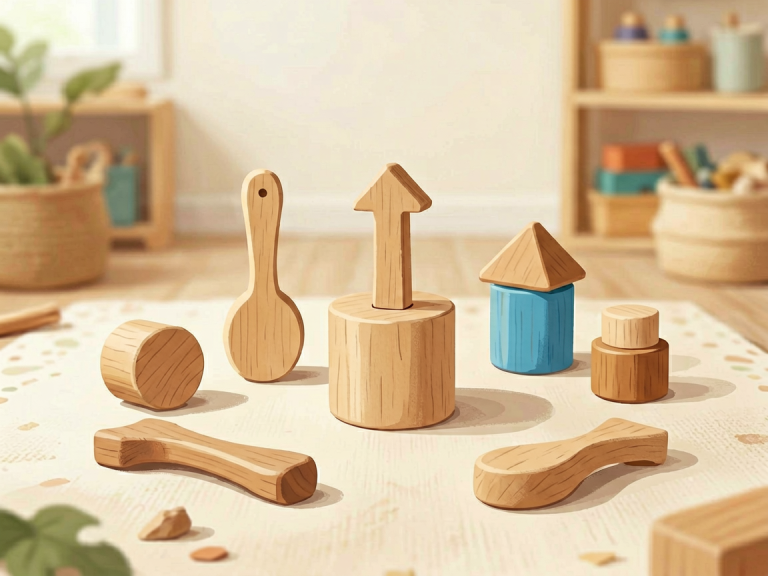
- Wooden Unit Blocks: Many sets come with small wooden cylinders and arches. Choose ones with edges that are sanded smooth.
5.2 Art and Craft Kits
- Large Perler Beads (5mm diameter): These require fine motor control to place on a pegboard. Always supervise closely; the beads are small enough to be a choking hazard if ingested. Use a bead tray with high sides.
- Stringing Beads (wooden or plastic, hole size at least 0.5 inches): A classic fine-motor activity. The beads themselves are large (1-inch cubes), but the string can be a strangulation hazard—use short strings less than 12 inches.
5.3 Educational Puzzles and Games
- Floor Puzzles with 48-100 pieces: The pieces are often chunky (about 1.5–2 inches on each side) and made of thick cardboard. They teach spatial reasoning.
- Board Games with Small Tokens: Games like “Candy Land” or “Chutes and Ladders” have small plastic figurines. Check that the figurines are too big to swallow (most are about 1.5 inches tall).
5.4 Pretend Play Accessories
- Dollhouse furniture (plastic or wood): Tiny chairs, tables, and beds. Look for sets where the smallest item (say, a teacup) is at least 1 inch across. Avoid sets with tiny food items like plastic grapes or peas.
- Construction vehicle sets: Small cars and trucks with detachable trailers. Ensure the wheels are firmly attached and cannot be pulled off.
—
Section 6: Common Mistakes Parents Make
6.1 Over-relying on Age Labels
Age labels are based on broad averages, but every child develops differently. A 5-year-old with a history of pica (eating non-food items) or a younger sibling who sneaks into the room might need stricter rules. Conversely, a mature 4-year-old might be ready for small parts earlier—but err on the side of caution.
6.2 Buying “Dollar Store” Small-Part Toys
Inexpensive toys often have poor quality control: parts may be brittle, paint may chip, and seams may split. A broken piece can create a sharp edge or a new choking hazard. Stick to reputable brands that test to ASTM F963 (the U.S. toy safety standard) or EN71 (European standard).
6.3 Assuming “Educational” Means Safe
Some STEM kits for 4–6 year olds include tiny screws, gears, and wires. While these are educational, they require very close supervision. Many such kits recommend age 6+ precisely because of the small parts. Read the fine print.
—
Section 7: When to Say No
There are some small-part toys that simply are not appropriate for 5-year-olds, regardless of the child’s maturity:
- Toys with loose magnets (including magnetic building sticks with exposed magnets)
- Jewelry-making kits with tiny beads (less than 5mm) and elastic string
- Miniature craft kits with glitter, sequins, or tiny pom-poms (these are difficult to clean up and can be inhaled)
- Any toy that comes with a warning that a part could be a choking hazard for children under 6—take that seriously.
Remember that 5-year-olds are still young enough to be unpredictable. They might chew on a plastic piece while watching TV, or pop a small marble into their mouth to “see what it tastes like.” The risk is low, but it is not zero.
—
Conclusion: Embrace the Challenge, Respect the Risk
Buying toys with small parts for a 5-year-old is not a simple yes/no decision. It is a continuous process of assessment—of the toy itself, of your child’s current behavior, and of the environment in which they play. The benefits are profound: small-part toys are among the most powerful tools for developing a 5-year-old’s fine motor skills, cognitive flexibility, and social competence. The key is to approach them with informed caution, not fear. Choose quality, supervise actively, and teach your child the basic rule: “Pieces go in the toy, not in your mouth.” With these strategies, you can turn a simple box of plastic parts into a gateway to a world of learning—one small, safe step at a time.
*(Word count: 1,547)*