Beyond Disposability: Rethinking Play with Educational Alternatives to Single-Use Toys
Introduction
Walk into any toy store today, and you will be greeted by aisles of brightly packaged, plastic-heavy toys designed for a single purpose: to entertain for a few minutes before being discarded. These single-use toys — character-themed trinkets, fast-food meal premiums, cheap battery-operated gadgets, and packaging-dependent novelties — dominate the market and, too often, our children’s playrooms. Yet a growing body of research in child development, environmental psychology, and sustainable education suggests that these toys do more harm than good. They not only contribute to the mounting plastic waste crisis but also limit the cognitive and creative growth of children by offering predetermined, closed-ended play experiences. As parents, educators, and conscious consumers, we urgently need to explore educational alternatives to single-use toys — options that are durable, open-ended, intellectually stimulating, and environmentally responsible. This article examines the multifaceted problem of disposable playthings and presents a comprehensive framework of meaningful substitutes that nurture lifelong learning.
—
1. The Problem with Single-Use Toys: Environmental and Developmental Costs
The first step toward change is understanding why single-use toys are problematic. Environmentally, the statistics are alarming. According to the Ellen MacArthur Foundation, the toy industry is one of the heaviest users of plastic, with up to 80% of all toys eventually ending up in landfills, incinerators, or oceans. A single plastic action figure can take hundreds of years to decompose, leaching toxic additives like phthalates and BPA into soil and water. Beyond the ecological toll, there is a developmental cost. Single-use toys often dictate a narrow script: press a button, hear a sound; wind a key, see a pre-programmed movement. Such toys leave little room for imagination, problem-solving, or adaptation. Children quickly lose interest because there is no challenge — the toy “plays itself.” As psychologist Alison Gopnik notes, children thrive in environments that allow them to experiment, hypothesize, and create. Closed-ended, disposable toys rob them of those opportunities. Moreover, the culture of disposability instills a consumerist mindset: every new desire is met with a new purchase, undermining patience, resourcefulness, and gratitude.
—
2. The Core Principles of Educational Alternatives
Before listing specific alternatives, it is vital to establish the principles that define a truly educational alternative to single-use toys. First, open-endedness: the toy or activity should invite multiple uses, interpretations, and outcomes. A set of wooden blocks, for example, can be a castle, a spaceship, a bridge, or a counting tool. Second, durability: the material should withstand repeated use and ideally be biodegradable, recyclable, or easily repairable. Third, agency: the child should be the primary actor, not a passive spectator. The toy should require effort, decision-making, and creativity. Fourth, developmental appropriateness: the alternative should align with the child’s current cognitive, motor, and social abilities while offering gentle challenges. Finally, low cost or free accessibility: many of the best educational alternatives come from nature, household items, or community resources, reducing economic burden and promoting equity. These principles guide the following suggestions.
—
3. Open-Ended Building Materials: Blocks, Loose Parts, and Modular Systems
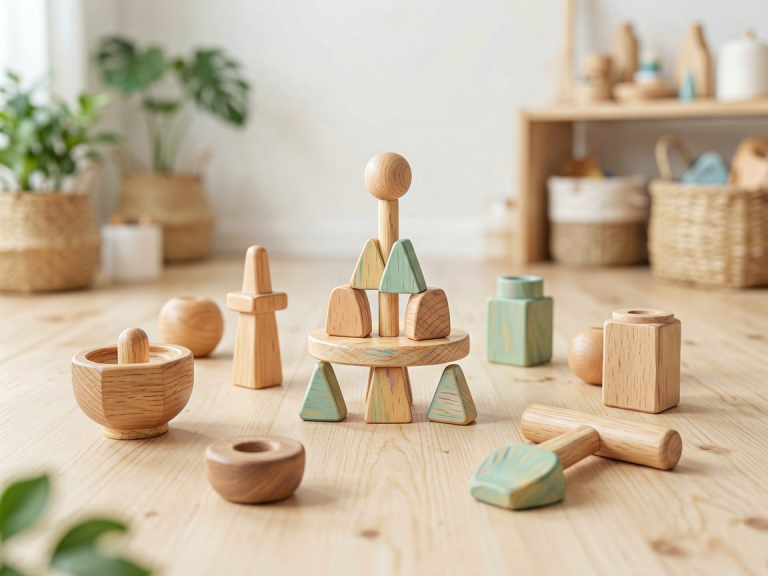
One of the most powerful educational alternatives is the category of open-ended building materials. Classic wooden unit blocks — a staple of Montessori and Reggio Emilia classrooms — allow children to explore geometry, balance, gravity, and symmetry. Unlike plastic construction sets that snap together in predetermined ways, wooden blocks offer infinite combinations. Similarly, “loose parts” theory, championed by architect Simon Nicholson, encourages the use of everyday objects like pebbles, bottle caps, fabric scraps, cardboard tubes, and pinecones. These materials have no fixed purpose; a cardboard tube can become a telescope, a rolling pin, or a tunnel for marbles. Loose parts foster divergent thinking, fine motor skills, and collaborative play. For older children, modular systems such as magnetic tiles, Geomag, or simple wooden gears provide structured but flexible challenges. They teach engineering principles, spatial reasoning, and persistence — values that a single-use toy can never convey.
—
4. Nature-Based Play: The Ultimate Free Resource
Nature itself is the richest and most sustainable educational alternative. A walk in the woods, a beachcombing session, or time in a backyard garden yields materials that outshine any plastic novelty. Sticks become wands, digging tools, or measuring rods. Leaves, flowers, and seeds offer lessons in biology, color, and texture. Mud, sand, and water provide sensory experiences that are both calming and intellectually stimulating. Researchers from the University of British Columbia have shown that children who engage in unstructured nature play develop better executive function, stress regulation, and environmental stewardship. Parents can create a “nature kit” with a magnifying glass, a small container for specimens, a sketchbook, and a field guide. Seasonal activities — such as leaf pressing, rock painting with water-based paints, or building fairy houses from twigs and moss — cost nothing and deepen a child’s connection to the living world. Nature never runs out of play possibilities, and it never becomes obsolete.
—
5. Creative Arts and Reusable Crafts: From Crayons to Recycled Materials
Art supplies are another excellent alternative, but the key is to choose reusable or repairable options over single-use craft kits. For example, traditional wax crayons, watercolor paints in refillable palettes, and modeling clay that can be reused after drying and rehydrating — these materials have a long life. A blank sketchbook encourages daily drawing, writing, and diagramming. In contrast, a single-use coloring book with licensed characters offers little creative input; the child merely fills in pre-drawn lines. Better to provide plain paper and let the child invent scenes. Similarly, recycling household waste — egg cartons, yogurt pots, fabric offcuts, bottle caps — into art projects teaches resourcefulness. A cardboard box can become a car, a robot costume, or a diorama. The process of planning, cutting, gluing, and decorating engages problem-solving, fine motor coordination, and even basic physics. When the creation is complete, it can be deconstructed and the materials reused — an implicit lesson in circular economy.
—
6. Digital Alternatives: Balancing Screen Time with Purposeful Apps
It would be disingenuous to ignore the role of digital technology in modern childhood, but we must distinguish between passive screen time and active, educational digital play. Single-use digital toys — such as apps that bombard children with microtransactions or offer mindless tapping without learning — are just as problematic as physical disposables. However, there are high-quality digital alternatives that embody the same open-ended, educational principles. Apps like Toca Boca’s “Toca Nature” allow children to create ecosystems, plant trees, and observe animal behaviors. ScratchJr teaches coding through storytelling and game creation. “Minecraft’s Creative Mode” is a virtual sandbox where players build with digital blocks, learning geometry, resource management, and collaboration. These tools are not disposable; they can be revisited and expanded over years. The key is to set time limits and, even more importantly, to co-play with the child, discussing choices, strategies, and outcomes. In this way, the screen becomes a tool for learning, not a pacifier.
—
7. The Role of Parents and Educators in Fostering Sustainable Play
Shifting from single-use toys to educational alternatives requires a cultural change, and parents and educators are at the forefront. First, they must model a mindset of intentionality: pause before buying a toy and ask, “Will this be used in ten different ways? Can it be repaired? Is it made of sustainable materials?” Encouraging children to appreciate what they already have — through toy rotations, repair workshops, and upcycling — builds gratitude and creativity. Educators can incorporate loose-parts play, nature journals, and maker spaces into the curriculum. They can also collaborate with families to host “toy swaps” or “recycled art challenges” that normalize non-consumerist play. Importantly, adults should resist the social pressure of the toy industry’s marketing. A child does not need the latest licensed figurine; they need time, space, and permission to explore. By reducing the quantity and increasing the quality of playthings, we allow children to dive deeper into their interests, fostering concentration and mastery.
—
8. Conclusion: A Shift in Mindset
The problem of single-use toys is not merely environmental; it is a problem of imagination. When we hand a child a plastic toy that does everything for them, we inadvertently teach them that learning is passive, that creativity is unnecessary, and that objects are disposable. The educational alternatives discussed in this article — from wooden blocks and nature play to recycled crafts and purposeful apps — offer a different path. They honor the child’s innate curiosity, respect the planet’s finite resources, and cultivate skills that last a lifetime: critical thinking, persistence, collaboration, and wonder. Making the switch does not require a wholesale replacement of every toy in the house. It begins with small, mindful choices: a walk outside, a box of loose parts, a shared conversation about where things come from. As more families and educators embrace these alternatives, we not only reduce waste but also nurture a generation of children who see the world as a place full of possibilities rather than products. The most educational toy is the one that never runs out of ideas — and that toy is the child’s own mind, supported by a rich, sustainable environment.