Beyond the Box: The Best Alternatives to STEM Kits for Toddlers
In the modern parenting landscape, brightly colored STEM (Science, Technology, Engineering, and Mathematics) kits promise to turn our toddlers into miniature geniuses. They glimmer with plastic gears, magnetic tiles, and pre-labeled test tubes. Yet for children under three, these kits often miss the mark. The true foundation of STEM thinking—curiosity, problem-solving, and observation—does not come from a box full of prescribed activities. It emerges from open-ended, sensory-rich experiences that honor a toddler’s natural drive to explore. This article moves beyond the commercial STEM kit and presents five powerful, research-backed alternatives that nurture the same skills without the constraints of a prefabricated curriculum.
1. The Power of Loose Parts: Nature’s Original STEM Kit
One of the most profound alternatives to structured STEM kits is the concept of loose parts play. Coined by architect Simon Nicholson in the 1970s, this theory holds that children’s creativity and cognitive development flourish when they have access to materials that can be moved, combined, redesigned, and used in countless ways.
For toddlers, loose parts are everywhere: pinecones, smooth stones, acorn caps, large wooden blocks, fabric scraps, cardboard tubes, and bottle caps. Unlike a STEM kit that dictates how a circuit must be built, loose parts invite a child to become an engineer, a mathematician, and a scientist all at once. When a toddler stacks stones, she experiments with gravity and balance—a hands-on physics lesson more authentic than any worksheet. When she fills a cardboard tube with pebbles and shakes it, she explores cause and effect, volume, and sound. The beauty of loose parts lies in their ambiguity. A single wooden ring can be a bracelet, a wheel, a cookie, or a stacking piece. This open-endedness is exactly what fuels divergent thinking, a cornerstone of true scientific inquiry.
Parents often worry that without a guide, their toddler “won’t learn anything.” But the opposite is true. A toddler who spends twenty minutes arranging pinecones by size is engaging in early measurement and classification. She is forming the neural pathways for pattern recognition and logical sequencing—skills that no plastic kit can teach as organically. To implement this alternative, simply gather safe, natural, and household items. Rotate them regularly to keep novelty alive, and resist the urge to direct the play. Let the child be the lead scientist.
2. Sensory Bins: The Ultimate Laboratory for Scientific Observation
STEM is fundamentally about observation and experimentation. For a toddler, the best laboratory is a sensory bin. Far superior to a rigid kit that might contain, say, a pre-mixed “volcano” pack, a sensory bin is a dynamic, ever-changing environment where a child can hypothesize, test, and revise.
Fill a shallow bin with a base material—dry rice, cooked spaghetti, kinetic sand, water beads, or even snow. Then add scoops, funnels, small containers, and objects of varying textures. A toddler who pours rice from one cup to another is exploring volume and conservation (a precursor to mathematics). When she buries a plastic animal in kinetic sand and digs it out, she practices object permanence and fine motor control. If you add a few drops of food coloring to water and let her mix the colors, she is conducting a chemistry experiment worthy of any preschool lab.
The key difference between a STEM kit and a sensory bin is agency. In a kit, the experiment is predefined: “Put the red water in the blue tube and watch it turn purple.” In a sensory bin, the child decides what to do. She might notice that wet sand holds its shape while dry sand crumbles. That discovery is hers alone, and it sticks far longer than a canned demonstration. To maximize STEM learning, ask open-ended questions during play: “What happens if you add more water?” “How many scoops do you think it will take to fill this cup?” These questions invite prediction and measurement without turning play into a lesson.
3. Construction with Real Tools: Wood, Fabric, and Gravity
While many STEM kits offer plastic snap-together pieces, toddlers crave the authenticity of real materials. A two-year-old’s brain is wired to understand the world through tactile, physical interaction. Wood, fabric, and simple tools provide a richer learning environment than any molded plastic.
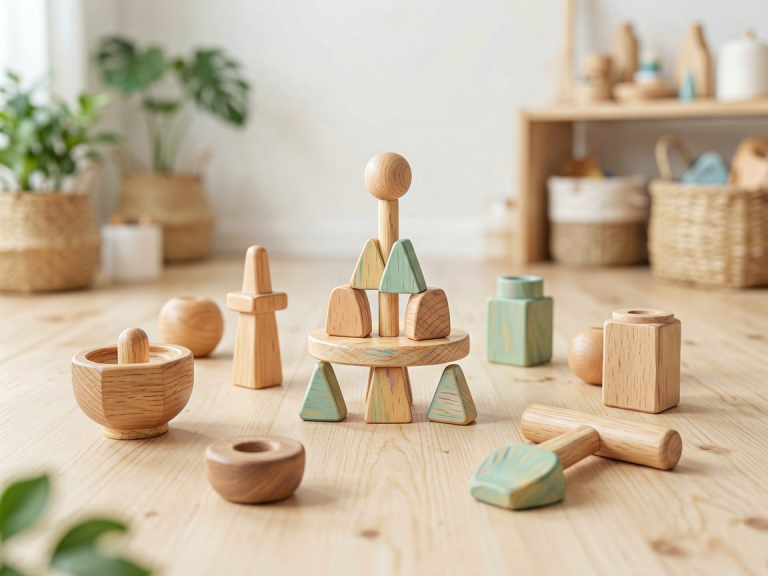
Wooden blocks are the classic example, but elevate them with additions like small wooden planks, dowels, and fabric squares. A child can build a tower, a bridge, or a “bed” for a toy bear. This is pure structural engineering. When a toddler learns that a tall, narrow block tower wobbles while a short, wide one stands firm, she has internalized an intuitive lesson about stability and center of mass. Add a small ramp and a toy car, and you introduce concepts of slope and acceleration.
Even more powerful are simple real tools under supervision: a child-sized hammer and wooden pegs, a screwdriver with large plastic screws, or a soft mallet for pounding golf tees into a Styrofoam base. These activities require hand-eye coordination, planning, and persistence—all essential STEM habits. Unlike the perfectly fitting pieces of a kit, real materials present friction, imperfect alignment, and unexpected outcomes. A block might not fit; a peg might bend. These moments of “failure” are actually the richest learning opportunities. They teach a toddler to adjust her strategy, to try again, and to accept that experimentation involves setbacks. No STEM kit can replicate the cognitive growth that comes from struggling with a stubborn wooden peg and finally succeeding.
4. Outdoor Exploration: The Infinite STEM Playground
Perhaps the most underutilized alternative to indoor STEM kits is the outdoors. Nature provides a multi-sensory, ever-changing STEM environment that no packaged product can match. Taking a toddler outside transforms every walk, every puddle, and every fallen leaf into a scientific investigation.
Begin with water play in a natural setting. A small stream, a muddy puddle, or even a bucket of rainwater offers endless opportunities. Why does a leaf float but a stone sink? What happens when you dam the flow with a stick? These are real questions that lead to real answers about density, flow, and displacement. Bug hunting under logs introduces biology and classification. A toddler who watches an ant carry a crumb is witnessing ecology in action. Collecting and sorting leaves by shape, color, or size builds classification and data collection skills—the very heart of statistics.
The outdoors also naturally encourages large-scale engineering. Digging a hole in the dirt, building a fort out of sticks, or rolling a ball down a hill are all exercises in physics and design. The unstructured time allows a child to follow her curiosity. She may spend ten minutes watching a spider web, then thirty minutes trying to roll a rock. The pace is slow, the observations are deep, and the learning is authentic. For busy parents, this alternative requires no preparation: just a jacket, a willingness to get dirty, and the discipline to let the child lead.
5. Everyday Kitchen Science: Cooking as a STEM Foundation
Many commercial STEM kits for toddlers include “kitchen science” experiments, but nothing beats the real thing. The kitchen is a perfect STEM classroom, packed with opportunities to measure, mix, observe, and predict. Best of all, toddlers love to help, and the “experiment” ends with a snack.
Consider simple activities like mixing dough. A toddler who helps mix flour and water is exploring states of matter. Why does the dough stick to her hands? What happens if she adds more water? She is engaged in real chemistry. Sifting flour introduces the concept of particle size. Sorting berries by color or counting apple slices builds early math. Watching butter melt on a warm pancake teaches about temperature and phase change. The kitchen also reinforces cause and effect in a concrete way: if you stir too hard, the batter splashes; if you bake the cookies too long, they turn brown.
The beauty of kitchen science is that it integrates all STEM disciplines naturally. The toddler is measuring (mathematics), observing (science), following steps (engineering process), and learning about tools (technology). Moreover, it builds practical life skills and a healthy relationship with food. To deepen the STEM connection, narrate the process: “We are scientists! Look how the water turns into steam.” Let the toddler taste, smell, and touch. The kitchen is a multi-sensory laboratory where failure is delicious—or at least educational.
Conclusion: Trusting the Toddler’s Inner Scientist
Commercial STEM kits for toddlers often promise a shortcut to intelligence. They offer convenience, bright colors, and the illusion of progress. But the best alternatives are not products at all—they are environments, materials, and relationships. Loose parts, sensory bins, real construction materials, outdoor exploration, and kitchen science all honor the toddler’s innate drive to understand the world. They foster the cross-disciplinary thinking that STEM really stands for, without the rigid boundaries of a pre-planned activity.
As parents and educators, our role is not to deliver knowledge but to create the conditions for discovery. By stepping away from the shiny box and embracing the messy, open-ended, and sometimes chaotic alternatives, we give our toddlers the greatest gift: the confidence to explore, ask questions, and build their own understanding of the world. That is the most powerful STEM foundation of all.