Beyond the Brick: The Best Alternatives to LEGO-Style Bricks for Toddlers
Introduction: Why LEGO Bricks Aren’t Ideal for Toddlers
Every parent knows the magical moment when a toddler’s eyes light up at the sight of colorful building blocks. LEGO bricks have long been the gold standard for creative construction, but for children aged one to three—the toddler phase—the classic LEGO system presents several problems. First and foremost, standard LEGO bricks are small. The iconic 2×4 brick measures just 32 mm by 16 mm, easily fitting into a curious toddler’s mouth and posing a serious choking hazard. Beyond safety, the fine motor skills of a toddler are still developing; the precise alignment and firm push required to connect two LEGO bricks can be frustrating rather than fun. The result? Tears, scattered pieces, and a shelf full of toys that go unused.
Fortunately, the toy industry has responded with a wealth of alternatives designed specifically for tiny hands and developing minds. These alternatives share the same educational benefits—spatial reasoning, creativity, problem-solving, and fine motor practice—but they come in larger sizes, softer materials, or with magnetic connections that make building intuitive and joyful. In this article, we’ll explore the ten best alternatives to LEGO-style bricks for toddlers, examining their unique features, developmental benefits, and safety profiles. Whether you are a parent, a caregiver, or an educator, this guide will help you choose the perfect building system for the little builder in your life.
Criteria for Selecting Toddler-Friendly Building Blocks
Before diving into specific products, it is important to understand what makes a building toy truly suitable for a toddler. The following criteria guided our selection:
- Size and Safety: All components must be large enough to prevent swallowing. The general rule is that pieces should be at least 1.5 inches (3.8 cm) in diameter or length. Non-toxic materials (BPA-free, phthalate-free) are non-negotiable.
- Ease of Connection: Toddlers have limited hand strength and coordination. The ideal block connects with a simple push, a gentle snap, or magnetic attraction. It should also come apart easily without causing frustration.
- Durability: Toddlers drop, throw, and chew on toys. Blocks must withstand rough play without cracking, chipping, or creating sharp edges.
- Versatility and Open-Ended Play: The best alternatives encourage free-form building rather than step-by-step instructions. A simple set of blocks should allow for towers, houses, animals, and imaginary scenes.
- Educational Value: Beyond fun, blocks should promote cognitive skills like color recognition, counting, balance, and spatial awareness. Some systems also introduce early STEM concepts.
- Cleanability: Toddler toys inevitably get sticky, dirty, or slobbered on. Blocks that can be wiped clean or washed in a dishwasher are a huge plus.
With these criteria in mind, let’s explore the top alternatives.
Top Alternatives to LEGO-Style Bricks for Toddlers
1. Mega Bloks First Builders – The Classic Large-Scale Brick
Mega Bloks (now owned by Mattel) created the “First Builders” line specifically for toddlers. These blocks are roughly twice the size of standard LEGO bricks—each block measures about 1.5 inches square and is hollow, making them lightweight yet sturdy. They snap together with a satisfying but gentle click and separate with minimal effort. The set includes basic shapes (squares, rectangles, cylinders) and often features characters or wheels for added play value.
Why it works for toddlers: The large size eliminates choking risks entirely. The bright primary colors appeal to young eyes, and the blocks are easy to grip with a whole-hand palmar grasp. Many sets come with a storage bag or bucket, teaching toddlers to clean up. Moreover, Mega Bloks are fully compatible with each other across different First Builders sets, so you can expand without worry.
Developmental benefits: Building towers improves hand-eye coordination and introduces cause and effect (“What happens if I stack one more?”). The act of snapping blocks together strengthens the small muscles in the hand, laying a foundation for later writing skills. And because the blocks are so forgiving, toddlers experience repeated success, building confidence.
One caveat: Some parents report that the blocks can be slightly too easy to separate, leading to accidental collapses. However, for the 18-month to 3-year age range, this is often a feature, not a bug. The frustration level remains low.
2. DUPLO by LEGO – The Official Toddler Line (But Is It an Alternative?)
Strictly speaking, DUPLO bricks are made by LEGO, but they are so different from standard LEGO bricks that they deserve a spot on this list. DUPLO bricks are exactly twice the size of classic LEGO bricks in every dimension, meaning they are large enough for toddlers while remaining compatible with standard LEGO bricks (on the bottom side). This compatibility is a unique advantage: when your child outgrows DUPLO, the bricks can be integrated into classic LEGO sets.
What sets DUPLO apart: LEGO invests heavily in themes and characters—Disney, trains, farm animals, fire stations—which can spark imaginative play. The bricks are incredibly durable, and the plastic is free from BPA, phthalates, and other harmful chemicals. The clutch power (the force needed to connect bricks) is calibrated to be slightly firmer than Mega Bloks, which some toddlers prefer once they reach age two.
Potential drawbacks: DUPLO is significantly more expensive than most alternatives. A basic set of 60 pieces can cost $20–30, while themed sets run much higher. Also, because the bricks are heavier than Mega Bloks, a tall tower can hurt if it falls on a toe. Still, for parents who value brand consistency and long-term play value, DUPLO remains a top contender.
3. Tegu Magnetic Wooden Blocks – Nature Meets Innovation
Tegu takes a completely different approach. Instead of plastic snaps, these blocks use hidden magnets embedded in sustainably sourced hardwood. Each block is coated with a non-toxic, water-based lacquer and comes in natural wood tones or vibrant colors. The magnetic polarity is carefully arranged so that blocks attract in multiple orientations, allowing for gravity-defying structures that seem magical to a toddler.
Why toddlers love them: The smooth wooden texture feels wonderful in small hands. Because magnets do the connecting, there is no need for precise alignment—just bring two blocks close, and they click together. This makes Tegu exceptionally easy for even the youngest toddlers (12 months and up) to use. The blocks are also very stable because magnets hold them firmly, so towers rarely collapse unexpectedly.
Developmental benefits: Tegu promotes an understanding of polarity and magnetic forces at an intuitive level. Children experiment with “this side sticks, that side pushes away.” The wooden blocks are also heavier than plastic, providing strong proprioceptive feedback—the sense of weight and force—which is crucial for motor planning.
Considerations: Tegu is expensive. A small starter set of 14 pieces costs around $35. Additionally, because the magnets are inside the wood, you cannot cut or modify the blocks. And if a magnetic block is chewed on aggressively, the wood can splinter. Supervise young toddlers who still mouth toys.
4. Magna-Tiles and PicassoTiles – The Magnetic Tile Revolution
Magnetic tiles have exploded in popularity over the past decade, and for good reason. Unlike bricks, tiles are flat geometric shapes (squares, triangles, rectangles) with strong magnets embedded in the edges. When you bring two tiles together, they snap into place, forming 2D or 3D structures. Magna-Tiles (made by Valtech) and the compatible PicassoTiles are the two leading brands.
Perfect for toddlers: The tiles are large—each square is about 3 inches across—so there is no choking hazard. The magnets are safely enclosed in plastic that is virtually indestructible. Most importantly, the building experience is incredibly forgiving. A toddler can simply lean two tiles against each other and watch them “stick.” The clear plastic allows light to pass through, creating beautiful rainbow patterns when placed near a window.
Educational highlights: Magnetic tiles teach geometry, symmetry, and basic engineering concepts. They also encourage collaborative play because they are easy to share. For toddlers, the sheer number of ways to combine tiles—building a cube, a house, a tunnel—sparks creativity without frustration. Many parents report that magnetic tiles remain a favorite well into elementary school.
Price and compatibility: Magna-Tiles are pricier than PicassoTiles, but both brands are compatible. A 32-piece PicassoTiles set costs about $35, making it one of the more affordable options. The only downside is that magnetic tiles do not “stack” in the same way bricks do; they are better for building enclosures and structures than tall towers. For a system that combines bricks and magnetism, consider the Tegu blocks mentioned earlier.
5. Plus-Plus BIG – The Puzzle-Like Building Experience
Plus-Plus is a Danish design toy that consists of small, single-piece “plus” shapes that interlock from all directions. The original Plus-Plus pieces are quite small (about 20 mm), but the company now offers Plus-Plus BIG, which is four times larger and specifically designed for toddlers. These pieces are chunky, easy to grip, and connect with a satisfying click. Because they are shaped like a plus sign, they can be connected in endless orientations: flat to create mosaics, or stacked to create 3D sculptures.
Why it stands out: Plus-Plus BIG is one of the few alternatives that encourages both 2D and 3D construction. Toddlers can lay pieces flat to make a picture, then add layers to make it pop. The pieces are made from polyethylene (the same material as cutting boards) and are dishwasher safe. They are also very lightweight, so a collapsing tower won’t hurt.
Fine motor benefits: Connecting Plus-Plus pieces requires a gentle push-friction fit, which is slightly more challenging than magnetic blocks but still well within a toddler’s ability. This helps develop pincer grip and finger strength. The repetitive action of joining pieces is also calming and meditative for many children.
Value note: Plus-Plus BIG sets are very reasonably priced. A 270-piece bucket costs around $25, giving you a huge number of pieces. However, the pieces are all the same shape, so the play is less varied than a set with blocks, wheels, and figures. Some toddlers may miss the variety of brick-style toys.
6. Bristle Blocks (Stickle Bricks) – Sensory Fun
Bristle blocks, often marketed as “Stickle Bricks,” replace the traditional stud-and-tube connection with an array of flexible, brush-like bristles. One block’s bristles interlock with another block’s bristles, creating a firm but reversible connection. These blocks come in a variety of shapes—cubes, wheels, arches—and many sets include animal heads or wheels.
Why toddlers adore them: The bristles provide a unique tactile sensation. Toddlers love running their fingers over the “hairs” and hearing the faint rustling sound when they connect. Because the bristles are forgiving, blocks can be joined at many angles, not just 90 degrees. This allows for organic, curved structures that are impossible with rigid LEGO bricks.
Safety and durability: Bristle blocks are made of soft, flexible plastic that is gentle on teeth and gums—a big plus for teething toddlers. They are also very large; each block measures around 3 inches. The only downside is that bristles can trap dust and crumbs, so regular cleaning is needed. Some parents also note that the bristles flatten over time with heavy use, reducing grip strength.
7. Soft Building Blocks (Foam or Fabric)
For the youngest toddlers—those just learning to sit up or crawl—soft building blocks are the safest option. Brands like Infantino, Bright Starts, and Sassy produce foam blocks covered in fabric or textured plastic. These blocks are extremely lightweight, completely silent, and impossible to hurt with. They come in cube shapes, pyramids, and half-circles, and often have additional sensory features like crinkle paper, squeakers, or mirrors.
Developmental focus: Soft blocks are all about sensory exploration and gross motor skills. A 9-month-old can bat at a block, pick it up, and mouth it safely. As the child grows, they learn to stack two or three blocks, then knock them down—the earliest form of cause-and-effect play. While soft blocks do not offer the same construction challenge as plastic bricks, they are an essential stepping stone.
Drawbacks: Soft blocks are difficult to connect. Some sets have simple hook-and-loop fasteners (Velcro) that allow stacking, but the stacks are wobbly. They also tend to be less durable; fabric blocks can get stained or lose stuffing over time. For a child over 18 months, transition to one of the harder alternatives is recommended.
8. Wooden Unit Blocks – The Time-Tested Classic
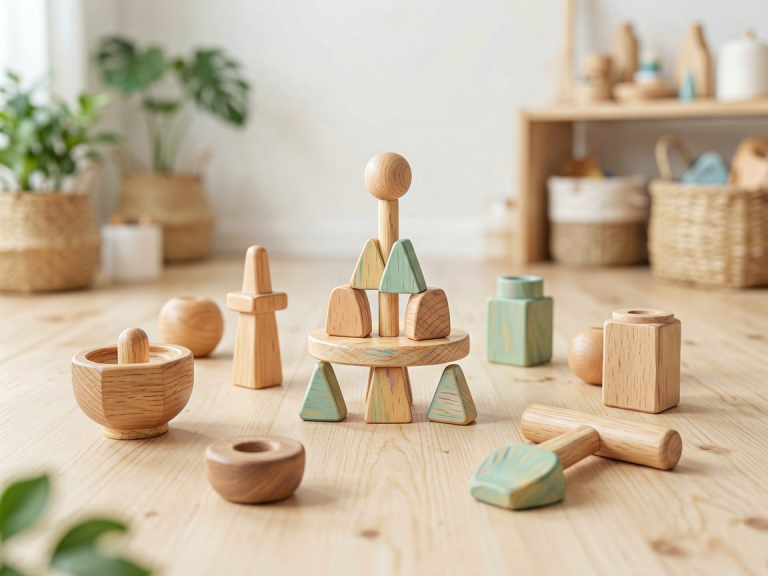
Before plastic LEGO bricks existed, children built with plain wooden blocks. Unit blocks—simple, unpainted hardwood blocks in standard mathematical proportions (e.g., the unit is a 1×2 rectangle)—remain one of the best educational toys ever created. Brands like Melissa & Doug, Guidecraft, and Hape produce safe, polished wooden blocks free of splinters.
Why they work for toddlers: Wooden blocks require no connection mechanism. Gravity and balance do all the work. This teaches toddlers about stability, weight, and friction in a very direct way. The blocks are heavy enough that they don’t slide around easily, yet a toddler can still lift them. The lack of any snap or magnet forces children to carefully align blocks, which hones visual-spatial skills.
Safety note: While wooden blocks are generally safe, choose sets with rounded edges and non-toxic finishes. Avoid painted blocks if your toddler still mouths toys heavily. Also, because wooden blocks are solid, a falling tower can be startling; supervise closely.
9. Clixo – Flexible Magnetic Tiles
A relatively new entrant, Clixo combines the flexibility of fabric with the power of magnets. Each piece is a flexible, rigid plastic shape with embedded magnets at the tips. Because the pieces can bend, toddlers can create curves, arches, and even rings that snap into place. Clixo is marketed for ages 3+ but many 2-year-olds can handle the larger pieces (the “Clixo Mini” version is even safer).
Unique appeal: Clixo pieces feel almost “alive” because they bend and hold their shape. Toddlers love watching a curved piece snap flat. The magnetic connection is strong but easy to separate. The set also includes wheels and connectors, allowing for simple movable creations.
Limitations: Clixo is expensive (a 14-piece pack is about $30) and the pieces are thinner than traditional blocks, which may be less durable. Additionally, the flexible plastic can get caught under furniture. Still, for a toddler who loves novelty, Clixo offers a completely different building experience.
10. Brio Builder System – Screws and Tools (for Older Toddlers)
Brio’s Builder System is a wooden construction toy that uses screws and a child-safe screwdriver to connect pre-drilled wooden blocks. This is a departure from brick-style stacking, but it teaches mechanical thinking. The pieces are large (about 4 inches long) and the screws are thick with rounded ends.
Best for ages 2.5 to 4: This system requires more dexterity and patience than other alternatives, so it is best for older toddlers who have mastered basic stacking. The feeling of turning a screw and watching two pieces lock together is deeply satisfying. Bright colors and wooden wheels add to the fun.
Safety and price: Brio products are heirloom-quality and very expensive—a starter set can cost $50–80. But they are virtually indestructible. Because screws are small parts, you must supervise carefully if your child still mouths objects. Many parents reserve this system for calm, seated play sessions.
Comparison at a Glance
| Alternative | Age Range | Material | Connection Method | Average Price (Starter Set) | Best For |
|————-|———–|———-|——————-|—————————–|———-|
| Mega Bloks First Builders | 12–36 months | Plastic | Snap (easy) | $15–20 | Budget-friendly, classic brick play |
| DUPLO | 18–36 months | Plastic | Snap (medium) | $20–30 | Brand reliability, theme lovers |
| Tegu Magnetic Wood | 12+ months | Wood + magnets | Magnetic | $30–40 | Sensory, open-ended, unique designs |
| Magna-Tiles / PicassoTiles | 18+ months | Plastic + magnets | Magnetic | $30–40 | Light-play, geometry, long-term use |
| Plus-Plus BIG | 18+ months | Polyethylene | Friction fit | $20–