Beyond the Brick: Top Alternatives to LEGO-Style Building Toys for 7-Year-Olds
For decades, LEGO bricks have been the gold standard in construction toys—versatile, durable, and endlessly creative. Yet as any parent or educator knows, no single toy is perfect for every child. At age seven, children are at a pivotal developmental crossroads: their fine motor skills are refined, their imagination is soaring, and their patience for complex, goal-oriented play is growing. While LEGO sets remain a wonderful option, exploring alternatives can open new avenues for learning, creativity, and skill-building. This article dives deep into the best alternatives to LEGO-style bricks specifically for seven-year-olds, examining their unique strengths, educational benefits, and why they might be the perfect fit for your child’s next playroom adventure.
Why Look Beyond LEGO?
Before we explore specific alternatives, it’s worth acknowledging that LEGO is not a monolithic experience. The classic brick system is brilliant, but it comes with constraints. Many LEGO sets are highly theme-driven (think Star Wars, Harry Potter, or Minecraft), which can sometimes limit open-ended building. Additionally, the small pieces can be a frustration for children who struggle with dexterity or who prefer larger, more tactile elements. Cost is another factor: official LEGO sets, especially licensed ones, can be expensive. Finally, some children simply crave different types of construction—ones that emphasize magnetism, motion, engineering principles, or even digital integration.
For a seven-year-old, the ideal alternative should:
- Challenge emerging problem-solving skills without causing frustration.
- Encourage both independent play and collaboration.
- Offer a clear sense of accomplishment—whether that means a working vehicle, a stable tower, or a programmable robot.
- Be durable, safe, and age-appropriate (no tiny choking hazards).
- Provide room for growth, so the toy remains engaging for at least a year or two.
With these criteria in mind, here are the standout contenders.
1. Magnetic Building Systems: The Power of Attraction
Magnetic tiles and rods have become a staple in many classrooms and homes—and for good reason. Brands like Magna-Tiles, Picasso Tiles, and Magnetiles (note: the generic term is “magnetic building tiles”) offer a completely different building experience from interlocking bricks. Instead of snapping plastic together, children use embedded magnets to connect translucent, geometric shapes.
Why They Work for Seven-Year-Olds
Seven-year-olds are old enough to understand the basic physics of magnetism without being bored by it. They can experiment with polarity, balance, and structural integrity in a way that feels like magic. The tiles are large enough (typically 3 inches or more) that they pose no choking risk, yet small enough to require deliberate placement. The transparency of the pieces adds a visual delight—children can build castles, rockets, animals, and abstract sculptures that catch light beautifully.
Educational Benefits
- Spatial reasoning: Building in 3D with magnetic connections forces children to think about angles, symmetry, and load-bearing walls.
- Early physics: Kids intuitively learn that opposite poles attract and same poles repel—a concept they’ll encounter formally in science class later.
- Collaboration: Magnetic tiles are easy to share; two or three children can build on the same structure without fighting over pieces.
Recommended Sets for Age 7
For this age group, avoid the 100-piece starter kits (too simple) and instead look for Magna-Tiles Clear Colors 100-Piece Set or Picasso Tiles 150-Piece Marble Run Set. The marble run add-on is particularly compelling: children build tracks and watch marbles cascade, combining construction with cause-and-effect experimentation. It’s like a STEM lab disguised as a toy.
Potential Downsides
Magnetic tiles are not as “figurative” as LEGO—you won’t be recreating a medieval castle with knights and dragons unless you buy separate figurines. Also, the magnets can lose strength over time if mistreated (though most sets are surprisingly robust). For a seven-year-old who loves storytelling and mini-figures, this might feel limiting. But for the child who adores geometry, engineering, and shiny things, it’s a worthy winner.
2. Wooden Block Systems: The Timeless Classic Reinvented
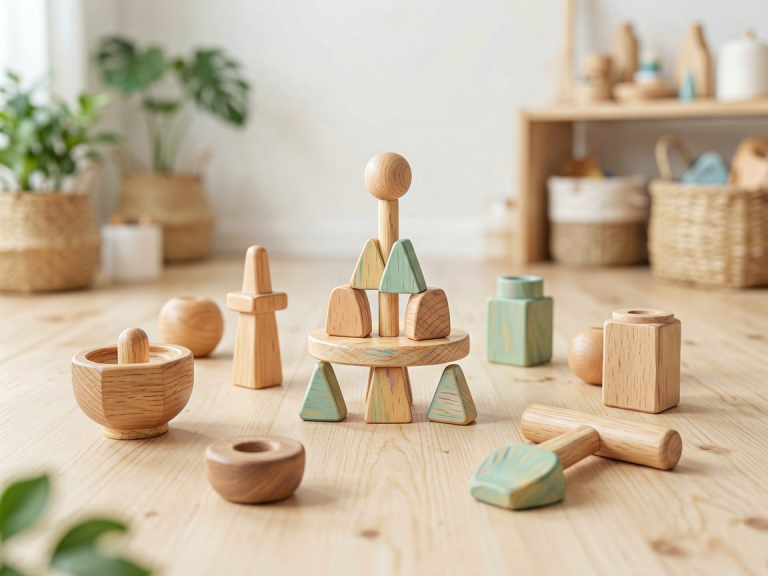
Wooden blocks have been around for centuries, but modern versions are far from your grandmother’s ABC blocks. Brands like Kapla, BRIO Builder, and Tegu have reinvented the wooden building experience with precise cuts, magnetic additions, and interlocking notches. For a seven-year-old, wooden blocks offer a sensory and cognitive experience that plastic simply cannot replicate.
Why Kapla Stands Out
Kapla planks are identical wooden pieces—roughly the size of a tongue depressor—that rely solely on friction and balance for construction. Without glue, magnets, or pegs, children must master the art of weight distribution to build towers, bridges, and even functional structures. A seven-year-old with patience can create architectural marvels that look like miniature skyscrapers.
Educational Benefits
- Patience and precision: Unlike LEGO, where pieces click easily, Kapla requires careful alignment. This builds hand-eye coordination and self-control.
- Engineering principles: Children learn about center of gravity, tension, and compression. A wobbly tower teaches more than a hundred instructions ever could.
- Open-ended creativity: There are no themes, no characters, no preset goals—just pure imagination. Some children will build houses; others will attempt a replica of the Eiffel Tower.
Why Tegu Adds a Twist
Tegu blocks have magnets embedded inside the wood, giving them the best of both worlds: the warmth of natural material plus the ease of magnetic connections. They are more expensive than Kapla, but they allow for structures that can defy gravity in pleasing ways. For a seven-year-old who gets frustrated when wooden blocks tumble, Tegu provides a forgiving alternative.
Potential Downsides
Wooden blocks can be noisier when they fall (and they will fall, repeatedly). They also lack the vibrant colors and narrative hooks of LEGO. If your child is deeply invested in minifigure-based role-play, wooden blocks might feel too abstract. But for the budding architect or engineer, they are a pure, brain-building delight.
3. Connector-Based Systems: Creativity Without Corners
Not all construction toys use the classic brick shape. Connector systems, such as K’NEX, Strawbees, and Zometool, use rods, joints, and flexible connectors to build frames, structures, and moving mechanisms. These toys are especially good for seven-year-olds because they introduce the concept of structural triangulation and mechanical motion.
K’NEX: The Roller Coaster King
K’NEX pieces consist of plastic rods that snap onto plastic connectors (like wheels or hubs). The system is famous for building roller coasters, cars, and cranes that actually move. For a seven-year-old, the thrill of constructing a working marble roller coaster is unmatched—it’s like engineering a tiny amusement park.
Educational Benefits
- Mechanical reasoning: Kids learn how gears, pulleys, and levers work. They see cause and effect in real time.
- Problem-solving: Building a K’NEX roller coaster requires iterative testing—does the marble make the loop? If not, adjust the angle.
- Sequential thinking: Following the instruction manual (or designing your own) teaches task sequencing.
Strawbees: The Low-Tech Marvel
Strawbees are simple plastic connectors that join ordinary drinking straws. They are incredibly cheap and infinitely reusable. With a box of Strawbees and a pack of straws, a seven-year-old can build a life-sized igloo, a catapult, or a giant insect. The open-ended nature encourages trial and error, and the large scale is empowering.
Zometool: Geometry for the Gifted
Zometool uses colored struts and ball-shaped nodes to build complex geometric forms like geodesic domes, crystals, and molecules. While it’s more suited for advanced builders, many seven-year-olds with a strong spatial sense will love the challenge. It’s a stealth math lesson—children internalize concepts like symmetry, tessellation, and vectors.
Potential Downsides
Connector systems can be fiddly; K’NEX pieces sometimes require firm pressure to snap together, which might strain small hands. Strawbees can be flimsy if overstretched. These toys also tend to look less “finished” than a LEGO model—your child may build a fantastic spaceship frame but feel it’s not as photographable as a brick-built one. However, the learning payoff is substantial.
4. Programmable Building Kits: The Digital Frontier
For the seven-year-old who loves technology, coding, or robots, programmable building kits are a fantastic alternative. Brands like littleBits, Makeblock mBot, and LEGO’s own Boost (wait—that’s still LEGO, but worth mentioning as a different system) offer brick-like components that integrate electronics and coding. However, for a true alternative, consider Botley 2.0 (a screen-free coding robot), Sphero BOLT, or Osmo Coding Starter Kit. These are not construction toys in the traditional sense, but they involve building and logic in equal measure.
Why littleBits Deserves a Look
littleBits are magnetic electronic modules that snap together to create circuits—lights, buzzers, motors, sensors. A seven-year-old can build a doorbell, a fan, or a drawing machine without any soldering. The modules are color-coded and large enough for small fingers. The educational value is clear: children learn electronics, cause-and-effect, and creative problem-solving. It’s like LEGO for electricity.
Makeblock mBot: Robotics with Real Gears
The mBot is a robot car kit that children assemble using metal parts, screws, and an Arduino-based controller. With a simple drag-and-drop coding interface (Scratch), they can program the mBot to follow lines, avoid obstacles, or even dance. For a seven-year-old, the building process is satisfying—screwing parts together feels grown-up—and the coding aspect is gamified.
Educational Benefits
- Coding literacy: Even drag-and-drop coding teaches sequential logic, loops, and conditionals.
- Electronics fundamentals: Understanding how a motor works or what a sensor does builds real-world tech literacy.
- Persistence: Debugging code or fixing a loose wire teaches resilience—a skill no brick can offer.
Potential Downsides
These kits are expensive and require adult supervision, at least initially. Some children may find the coding interface frustrating if they’re not already comfortable with tablets or computers. Also, the building is less about creativity and more about assembly—once the mBot is built, the play is mostly about coding, not rebuilding. For a child who loves pure construction, this might feel restrictive.
5. Hybrid Systems: The Best of Multiple Worlds
Some toys blend the tactile joy of bricks with the kinetic energy of moving parts or the infinite possibilities of software. Minecraft Earth (though AR-based) and Osmo’s Monster game don’t replace physical building, but Mecabricks (a digital LEGO builder) and Bloxels (a physical pixel board for creating video games) are worth mentioning.
Bloxels: Build a Video Game, Block by Block
Bloxels is a physical board with colored blocks that you place to create a video game level. Once you snap a photo with the app, your creation becomes playable. For a seven-year-old, this merges the satisfaction of building with the excitement of digital interactivity. It’s not a substitute for structural building, but it’s a brilliant creative outlet.
Why Choose Hybrid Over Pure Brick?
If your child is bored with static models, hybrid toys offer dynamic feedback. They see their creation move, light up, or interact on a screen. This can reignite interest in building for children who have outgrown traditional block play.
How to Choose the Right Alternative for Your 7-Year-Old
No single toy fits all children. Consider these questions:
- Does your child love motion (roller coasters, cars, robots)? → Choose K’NEX or mBot.
- Does your child prefer aesthetics (beautiful structures, symmetry, color)? → Choose magnetic tiles or Kapla.
- Is your child tech-savvy or curious about how things work? → Choose littleBits or Sphero.
- Does your child like open-ended, quiet play with natural materials? → Choose wooden blocks or Strawbees.
Also, consider what the child already has. If they’ve exhausted LEGO, start with something completely different—like magnetic tiles or a programmable robot. If they’ve never built with anything else, a connector system like K’NEX might be a gentle introduction to a new type of construction.
Conclusion: Expanding the Building Universe
LEGO bricks are a wonderful starting point, but they are not the only path to creative construction. For a seven-year-old, the world of building toys is vast and varied. Magnetic tiles teach spatial reasoning and physics through colorful, transparent geometry. Wooden blocks like Kapla and Tegu offer a meditative, architectural challenge that hones patience and balance. Connector-based systems like K’NEX bring mechanics and motion into the playroom. Programmable kits like littleBits and mBot introduce coding and electronics in a tangible, building-first way.
The best alternative is the one that matches your child’s current passions and developmental needs. A child who loves to follow instructions might bloom with a K’NEX roller coaster. A child who loves to experiment might thrive with magnetic tiles and a marble run. A child who dreams of becoming an engineer might find a lifelong hobby in littleBits or mBot.
Ultimately, the goal of any building toy is not just to produce a finished model, but to cultivate a mindset—one that embraces trial and error, celebrates creativity, and understands that even a collapsed tower is a lesson learned. Whether your child is stacking magnetic tiles or coding a robot to navigate a maze, they are building more than a structure; they are building problem-solving skills, confidence, and a love for learning. So step away from the brick aisle and explore these remarkable alternatives. Your seven-year-old’s imagination will thank you.