The Montessori Toy Debate: A Balanced Look at the Pros and Cons
Introduction
In recent years, Montessori toys have gained remarkable popularity among parents, educators, and early childhood development advocates. Inspired by the educational philosophy of Dr. Maria Montessori, these toys are designed to foster independence, concentration, and a love for learning through hands-on, self-directed play. Unlike conventional toys that often prioritize flashy lights, sounds, or passive entertainment, Montessori toys are typically made from natural materials, feature simple designs, and serve specific developmental purposes. However, while many enthusiasts praise their benefits, critics point out several limitations. This article explores both the advantages and disadvantages of Montessori toys, providing a comprehensive overview for parents and educators who are considering incorporating them into a child’s environment.
What Are Montessori Toys?
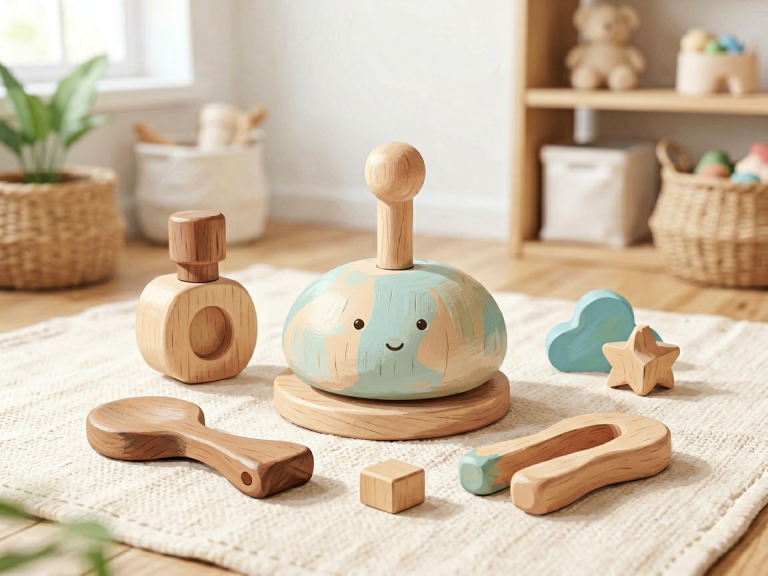
Montessori toys are not just a brand or a specific set of products; they are a category defined by core principles. They are usually crafted from wood, cotton, or metal, avoiding plastic and electronic components. Each toy focuses on a single skill—such as fine motor coordination, sensory discrimination, or mathematical understanding—and often includes a built-in “control of error,” meaning the child can see and correct their own mistakes without adult intervention. Examples include wooden stacking rings, knobbed cylinders, sandpaper letters, and bead chains. The philosophy behind these toys is that children learn best when they are free to explore at their own pace, in a prepared environment that respects their natural development.
The Pros of Montessori Toys
1. Encourages Independence and Self-Directed Learning
One of the greatest strengths of Montessori toys is that they empower children to learn on their own. Because these toys are designed with clear, sequential steps and self-correcting features, a child can figure out how to use them without constant adult guidance. For instance, a simple puzzle with a knob on each piece allows a toddler to grasp, lift, and place the piece back into its corresponding hole. If the piece does not fit, the child immediately sees the mismatch and can try again. This process builds resilience, patience, and confidence. Over time, children develop a sense of ownership over their learning, which can translate into a lifelong love of discovery.
2. Promotes Deep Concentration and Focus
Montessori toys are intentionally minimalist, with no distracting noises or flashing lights. This simplicity invites children to engage fully with the task at hand. A child working on a set of pink tower blocks, for example, must carefully align each cube from largest to smallest—a task that demands concentration, hand-eye coordination, and spatial awareness. Educators and parents often report that children using Montessori toys enter a state of “flow” where they become completely absorbed. Such sustained attention is crucial for later academic success and executive function development.
3. Supports Sensory and Motor Skill Development
Many Montessori toys are designed to refine the senses. The famous “sound cylinders” help children distinguish subtle differences in sound; the “rough and smooth boards” train tactile perception; the geometric cabinet sharpens visual discrimination. Fine motor skills are systematically strengthened through activities like transferring beads with tweezers, pouring water from a pitcher, or threading laces. Because the toys are multisensory and involve real-world materials (wood, metal, glass), children gain a richer understanding of weight, texture, temperature, and cause-and-effect than they would from plastic alternatives.
4. Teaches Problem-Solving and Logical Thinking
Montessori toys often present a clear challenge that requires logical reasoning. For instance, a set of number rods helps children grasp the concept of quantity and length order. A “binomial cube” introduces basic algebra in a physical, visual way. As children manipulate these objects, they learn to sequence, classify, compare, and hypothesize. This type of cognitive engagement is far more active than watching a screen or pressing a button, and it builds foundational skills in mathematics and science.
5. Environmentally Friendly and Durable
Because Montessori toys are typically made from natural, sustainable materials, they are often more eco-friendly than mass-produced plastic toys. Wood, when sourced responsibly, is renewable and biodegradable. Moreover, the high quality of construction means these toys can last for many years, even through multiple children. Many families pass down Montessori materials as heirlooms. In an era of disposable consumerism, this durability is both economical and environmentally sound.
The Cons of Montessori Toys
1. High Cost and Limited Accessibility
One of the most frequently cited drawbacks is the price. Authentic Montessori toys—especially those from established brands like Nienhuis, Montessori Outlet, or small artisan workshops—can be expensive. A single set of knobbed cylinders, for example, may cost $50 to $100 or more. A full collection for a classroom or home can run into hundreds or thousands of dollars. This creates an economic barrier that prevents many families from accessing these tools. While cheaper imitations exist, they often lack the precise craftsmanship, quality of materials, and educational integrity of the originals, which can undermine the intended benefits.
2. Limited Social Interaction and Collaborative Play
Montessori toys are designed for individual, focused work. The philosophy emphasizes “normalization” through solitary concentration, which can be wonderful for certain personality types. However, young children also need opportunities for cooperative play, negotiation, and group problem-solving. If a child’s environment is filled exclusively with solo Montessori materials, they may miss out on learning how to share, take turns, or resolve conflicts with peers. Some critics argue that the very structure of Montessori toys can inadvertently discourage the messy, open-ended social play that helps develop empathy and communication skills.
3. Over-Simplification and Lack of Imaginative Elements
Montessori toys are purposeful and skill-specific, but this can come at the cost of imaginative or open-ended play. A classic wooden block set, for instance, can be used to build castles, spaceships, or anything the child dreams up—but most Montessori materials have a prescribed method of use. A “pink tower” is meant to be stacked in a specific order, not as a prop for storytelling. While there are some Montessori-friendly open-ended toys (like plain wooden blocks or play silks), the core curriculum is largely structured. For children who thrive on fantasy, pretend play, or creative improvisation, a purely Montessori toy collection may feel restrictive.
4. Requires Adult Preparation and Knowledge
Montessori toys are not inherently “educational” if simply handed to a child without context. The approach demands that adults—parents or teachers—understand the sequence of skills and how to introduce materials at the right time. A child who is presented with a complex puzzle before mastering simpler ones may become frustrated and lose interest. Moreover, maintaining a prepared environment where toys are displayed on low shelves, rotated periodically, and kept orderly requires effort and consistency. Busy families or those unfamiliar with Montessori principles may find it challenging to implement effectively, potentially leading to wasted investment and disappointment.
5. Not Suitable for Every Child’s Learning Style
Just as no single educational method works for all children, Montessori toys may not resonate with every temperament. Some children are naturally kinetic, preferring large movements and physical play rather than the small, precise manipulations that many Montessori activities require. Others may be auditory or visual learners who benefit more from storytelling, music, or digital interactions. Forcing a child who is disinterested into a Montessori toy rotation can create resistance or boredom. The best approach is to consider the child’s unique profile and offer a balanced mix of play experiences.
Conclusion
Montessori toys offer a thoughtful, research-informed approach to early childhood development, with clear benefits in fostering independence, concentration, sensory refinement, and logical thinking. Their natural materials and durability also align with sustainable values. However, they are not a panacea. Their high cost, potential to limit social and imaginative play, and the need for informed adult guidance are significant considerations. Ultimately, the decision to use Montessori toys should be based on the child’s individual needs, the family’s budget, and a willingness to supplement them with other types of play. A balanced environment that includes both structured Montessori materials and open-ended, cooperative, imaginative opportunities is likely to provide the richest developmental foundation. As with any tool, the key lies not in the toy itself, but in how it is integrated into a child’s holistic experience of learning and growing.