Magnetic Tiles vs. Wooden Blocks: Which Building Toy Best Suits a 7-Year-Old?
Introduction
At the age of seven, children stand at a fascinating crossroads of development. They have left behind the purely sensory exploration of toddlerhood and are entering a phase where imagination, logic, and social play converge. Their fine motor skills are more refined, their attention spans longer, and their cognitive hunger for cause-and-effect relationships is insatiable. For parents and educators, choosing the right building toy becomes a meaningful investment in a child’s growth. Two perennial favorites dominate the landscape: classic wooden blocks and modern magnetic tiles. Both offer rich play experiences, but they are far from identical. This article delves deeply into the characteristics, benefits, and potential pitfalls of each, providing a comprehensive guide for anyone seeking the ideal construction toy for a seven-year-old. By examining developmental psychology, educational outcomes, and practical family needs, we will uncover which option—or combination—truly maximizes the potential of this critical age.
1. The Developmental Landscape of a 7-Year-Old
Before comparing the toys, it is essential to understand the child who will use them. A seven-year-old typically exhibits several key traits. Cognitively, they are in Piaget’s concrete operational stage, meaning they can think logically about concrete events but still struggle with abstract concepts. They love rules, patterns, and sequences. Socially, they begin to form stronger peer bonds and enjoy cooperative play, though parallel play still occurs. Emotionally, they seek a sense of mastery and can become frustrated if challenges exceed their abilities. Physically, their hand-eye coordination is good enough to handle precision tasks, but large-muscle strength is still developing. A toy that meets these needs must offer enough complexity to sustain interest, enough flexibility to encourage creativity, and enough structure to provide a sense of accomplishment. Both magnetic tiles and wooden blocks can satisfy these requirements, but they do so through different mechanisms.
2. Wooden Blocks: Timeless Foundations of Creativity
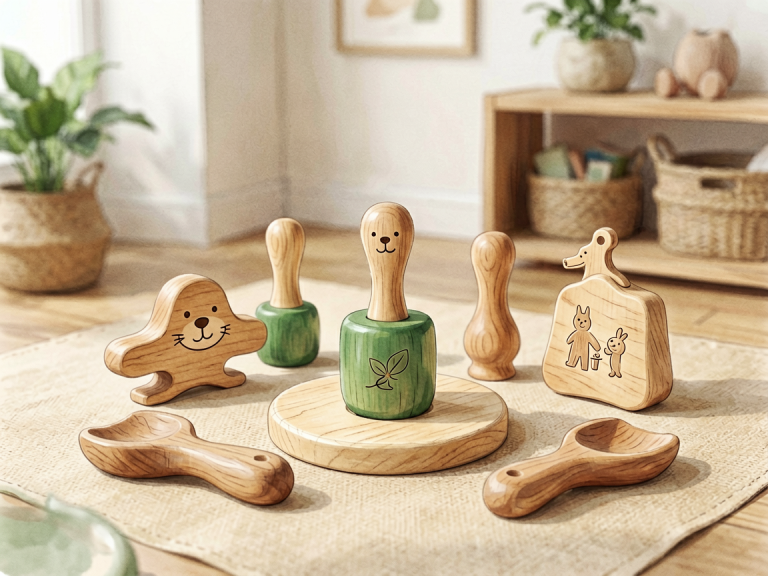
Wooden blocks have been a staple of childhood for centuries, and for good reason. For a seven-year-old, they provide an open-ended, tactile experience that is deeply rooted in physical reality. Each block has weight, texture, and a fixed shape. Stacking them requires careful balancing, which trains the child’s proprioception and understanding of gravity. Unlike magnetic tiles, which snap together with instant satisfaction, wooden blocks demand patience. A tower that wobbles teaches lessons about center of mass and structural integrity that no digital simulation can replicate.
2.1 Cognitive and STEM Benefits
Playing with wooden blocks naturally introduces basic physics. A seven-year-old quickly learns that a tall, narrow base is unstable, while a wide, low base supports a taller structure. They experiment with friction—smooth blocks slide, while rough ones grip. They also engage in spatial reasoning: rotating a rectangular prism to fit into a gap, or estimating how many cubes are needed to fill a container. These are foundational skills for geometry and engineering. Moreover, because wooden blocks lack magnets, children must rely on precision placement. Mistakes are visible and correctable. This trial-and-error process builds resilience and problem-solving abilities. Research in early childhood education consistently shows that block play correlates with improved math scores and executive function in later years.
2.2 Creative and Imaginative Play
Wooden blocks are neutral. They do not dictate a specific form—a cylinder can be a tree trunk, a castle turret, or a rocket ship. This ambiguity is a gift for a seven-year-old’s imagination. They can build a medieval fortress one day and a futuristic city the next. The blocks also integrate seamlessly with other toys, such as toy cars, dolls, or action figures. This cross-play encourages narrative development and storytelling. There is no “right” way to use wooden blocks, which reduces performance anxiety and allows the child to explore without fear of failure.
2.3 Social Interaction and Language Development
When two seven-year-olds play together with wooden blocks, they must negotiate. Who gets the long plank? How high should the tower go? What happens if it collapses? These moments foster cooperation, turn-taking, and conflict resolution. Unlike digital games, block play is synchronous and physical. Children use rich language to describe their actions: “I’ll put this one here, and you add that triangle on top.” The tactile nature also grounds them in the present moment, reducing overstimulation often associated with bright screens or flashy electronic toys.
2.4 Limitations of Wooden Blocks
Despite their strengths, wooden blocks have drawbacks. For some seven-year-olds, the lack of inherent connection can be frustrating. A wobbly structure easily topples, leading to sudden disappointment. Additionally, building complex arches or cantilevers is difficult without glue or connectors. The child may feel limited by the simple stacking and balancing mechanics. Cleanup can also be cumbersome—blocks tend to scatter, and sorting them by shape and size requires patience. Finally, quality wooden blocks are expensive, and cheap ones may splinter or have toxic paints.
3. Magnetic Tiles: Modern Marvels of Engineering
Magnetic tiles, such as Magna-Tiles or Picasso Tiles, represent a more recent innovation. They are translucent, colorful plastic shapes embedded with magnets along their edges. When two edges approach, they snap together effortlessly, allowing children to construct three-dimensional structures quickly and with stability. For a seven-year-old, this instant gratification can be highly motivating.
3.1 Cognitive and STEM Benefits
Magnetic tiles excel at teaching geometric and engineering principles. Because the magnets hold the pieces together, children can build bridges, domes, and even rotating mechanisms with ease. They learn about magnetism (opposite poles attract, like poles repel), symmetry, and 2D-to-3D transformation. A common activity involves creating a cube from six squares—a perfect hands-on introduction to nets and polyhedra. Unlike wooden blocks, magnetic tiles allow for dramatic cantilevers and enclosures without collapse. This empowers children to experiment with architecture that would be impossible with standard blocks. For example, a seven-year-old can build a geodesic dome from triangles, a structure that requires precise angles. This fosters early understanding of structural engineering.
3.2 Creative and Imaginative Play
The translucent quality of magnetic tiles adds an aesthetic dimension. When held up to a window or used with a light table, they cast colorful shadows. Children often create stained-glass-like pictures or build castles with glowing rooms. The magnetic connection also means they can build vertically and horizontally with equal ease, enabling spaceships, houses, and even abstract sculptures. However, the play is somewhat more constrained than with wooden blocks. The pieces have predetermined shapes and magnetic orientations. A triangle cannot be a tree trunk as easily as a wooden triangle can; it is clearly a triangle. This specificity can sometimes limit open-ended storytelling. That said, many children adapt by assigning roles: the square becomes a window, the rectangle a door, and the triangle a roof.
3.3 Social Interaction and Language Development
Magnetic tiles promote collaborative play through shared construction projects. Because the pieces snap together firmly, a group of children can work on a massive structure without worrying about it collapsing under its own weight. This reduces frustration and encourages longer, more complex projects. They learn to distribute tasks: one child holds the base, another adds the roof. The play also teaches basic engineering vocabulary—words like “stable,” “angle,” “base,” and “balance.” However, one potential downside is that the magnets can make disassembly difficult for small hands. Children may need adult help to separate tightly joined pieces, which can interrupt the flow of play. Additionally, the bright colors and shiny surfaces can be overstimulating for some children, leading them to focus on aesthetics rather than construction logic.
3.4 Limitations of Magnetic Tiles
The most significant limitation is the expense. Quality magnetic tile sets are significantly pricier than wooden block sets of comparable piece counts. They also require more careful storage, as the magnets can interfere with electronics or be damaged if dropped repeatedly. Over time, the plastic may scratch, and the magnets can weaken or become dislodged, though reputable brands are durable. Furthermore, because pieces snap together so easily, there is less demand for fine-motor precision. Some educators argue that this reduces the development of hand strength and manual dexterity compared to wooden blocks. Finally, magnetic tiles are a relatively “closed” system—they work best only with their own brand or compatible sets. Wooden blocks, by contrast, can be mixed with any other wooden toy.
4. Comparative Analysis: Cognitive, Social, and Physical Benefits
To decide which toy is superior for a seven-year-old, we must weigh the specific developmental outputs. A side-by-side comparison reveals distinct strengths.
| Criterion | Wooden Blocks | Magnetic Tiles |
|———–|—————|—————-|
| Fine Motor Skills | High: requires precise placement and balancing | Moderate: snap-on action reduces need for precision |
| Spatial Reasoning | High: 3D stacking and gravity awareness | High: 2D-to-3D transformation and geometry |
| Physics Understanding | Gravity, friction, moment of force | Magnetism, structural stability, load distribution |
| Imaginative Flexibility | Very high: neutral shapes adapt to any narrative | Moderate: shapes are specific, less open-ended |
| Collaborative Play | Good: negotiation and conflict resolution | Excellent: stable structures enable large groups |
| Frustration Tolerance | High: collapse teaches resilience | Low: quick success may limit coping with failure |
| Durability | Very high: solid wood lasts decades | Moderate: plastic can scratch, magnets can weaken |
| Cost | Variable: cheap sets exist but quality costs | Generally expensive, especially large sets |
| Educational Alignment | Early STEM (physics, balance) | Geometry, engineering, magnetism |
For a seven-year-old, the choice may depend on the child’s temperament. A child who is easily frustrated might benefit more from magnetic tiles, as they provide consistent success. A child who thrives on challenges and enjoys refining techniques may prefer wooden blocks. Moreover, a balanced approach—owning both—is often ideal, as they offer complementary experiences.
5. Practical Considerations: Budget, Space, and Durability
Practicality cannot be ignored. Wooden blocks can be stored in a simple bin or on a shelf. They are quiet during play, which is a bonus in apartments or shared spaces. They are also non-electronic and require no batteries. However, they are heavy—a large wooden block set can be cumbersome for a child to move alone. Magnetic tiles are lighter and easier to transport, but they require a flat surface, and loose pieces may attract dust or hair. Cleaning magnetic tiles is simple (a damp cloth), whereas wooden blocks may need occasional oiling to prevent drying. In terms of longevity, high-quality wooden blocks can be passed down for generations, while magnetic tiles’ magnets may eventually lose strength. For a seven-year-old who may abandon the toy in a few years, cost-per-use should be calculated.
6. Making the Right Choice for Your Child
Ultimately, the best toy is the one that your child will actually play with. Observe their natural inclinations. Do they enjoy meticulous, slow-building activities? Wooden blocks. Do they crave instant results and ambitious structures? Magnetic tiles. Consider also the social environment: if your child often plays with friends who already have one type, compatibility matters. For classroom settings, many early childhood educators recommend magnetic tiles for group STEM activities and wooden blocks for free-play stations. For home, a mixed approach works wonders. Start with a mid-sized magnetic tile set to spark enthusiasm, then add a wooden block set for deeper creative engagement.
Conclusion
Both magnetic tiles and wooden blocks have earned their place in the toy chest of a seven-year-old. Wooden blocks ground children in the tangible world of physics, patience, and imagination, while magnetic tiles propel them into the world of modern engineering, geometry, and collaborative success. Neither is universally “better.” The key lies in understanding your child’s developmental stage, personality, and play preferences. By providing a variety of building toys, you are not just buying entertainment—you are crafting a scaffold for cognitive growth, social skills, and a lifelong love of creation. Whether they choose to stack, snap, balance, or bridge, the most important thing is that they build. And in doing so, they build themselves.