The Art of Toy Selection: A Comprehensive Guide to Comparing Toys with Expert Tips
Choosing the right toy for a child can feel like navigating a labyrinth of colorful boxes, flashing lights, and endless marketing claims. Parents, educators, and gift-givers alike often find themselves overwhelmed by the sheer volume of options available in stores and online. How do you decide between a wooden puzzle and a plastic tablet? Between a stuffed animal that sings and one that simply sits quietly? Between a science kit and a dollhouse? The answer lies in learning how to compare toys systematically. This article provides a detailed, research-backed framework for comparing toys, offering practical tips that will help you make informed, thoughtful decisions that support a child’s development, safety, and joy.
Understanding the Core Purpose of Toy Comparison
Before diving into specific tips, it is essential to recognize that comparing toys is not about finding the “best” toy in an absolute sense. Rather, it is about matching a toy’s features to a specific child’s age, interests, developmental stage, and environment. A toy that is perfect for a curious five-year-old may frustrate a two-year-old or bore a ten-year-old. The goal of comparison is to evaluate multiple dimensions simultaneously: educational value, safety, durability, cost, and long-term engagement. By developing a structured comparison mindset, you avoid impulse purchases and instead curate a toy collection that fosters creativity, learning, and lasting fun.
Key Question: What Are You Comparing For?
Before you begin, clarify your objective. Are you comparing toys for a birthday gift? For a classroom? For a long car trip? For a child with specific sensory needs? Each context changes the weight you assign to different factors. For example, a travel-friendly toy should be compact and quiet, while a classroom toy should encourage group play and be easy to sanitize. Recognizing the purpose of your comparison is the first step toward making a wise choice.
Tip 1: Compare Developmental Appropriateness – Age Does Matter
One of the most critical yet frequently overlooked aspects of toy comparison is developmental alignment. A toy that claims to be “for ages 3+” may still be inappropriate if the child’s fine motor skills or cognitive abilities are not yet ready for its demands. When comparing toys, always check the manufacturer’s age recommendation, but also rely on your understanding of the child’s individual development.
How to Compare Across Age Stages
- Infants (0–12 months) : Focus on sensory stimulation, cause-and-effect, and safe mouthability. Compare toys based on textures, sounds, and high-contrast colors. Avoid small parts or long strings.
- Toddlers (1–3 years) : Look for toys that encourage large motor skills, simple problem-solving (shape sorters, stacking rings), and pretend play. Compare durability – toddlers throw and drop toys frequently.
- Preschoolers (3–5 years) : Prioritize toys that foster imagination, early math and literacy concepts, and social interaction. Compare open-ended toys (blocks, play dough) versus closed-ended toys (puzzles with one solution).
- School-Age Children (6–12 years) : Compare toys that build specific skills: strategy games, science kits, construction sets, and creative arts. Also consider complexity and how long the toy will remain challenging.
A practical tip: when comparing two similar toys, look at the “challenge level.” For example, compare two building sets – one with 50 pieces and simple connectors versus another with 200 pieces and complex gears. Choose based on the child’s current skill level, not their potential future level. A toy that is too hard leads to frustration; one too easy leads to boredom.
Tip 2: Compare Educational Value – Beyond the “Learning” Label
Many toys are marketed as “educational,” but the term is often vague. When comparing toys, dig deeper to identify the specific cognitive, physical, or social-emotional skills they actually promote. A good practice is to ask: “What will this child learn by playing with this toy that they wouldn’t learn from another?”
Categories of Educational Comparison
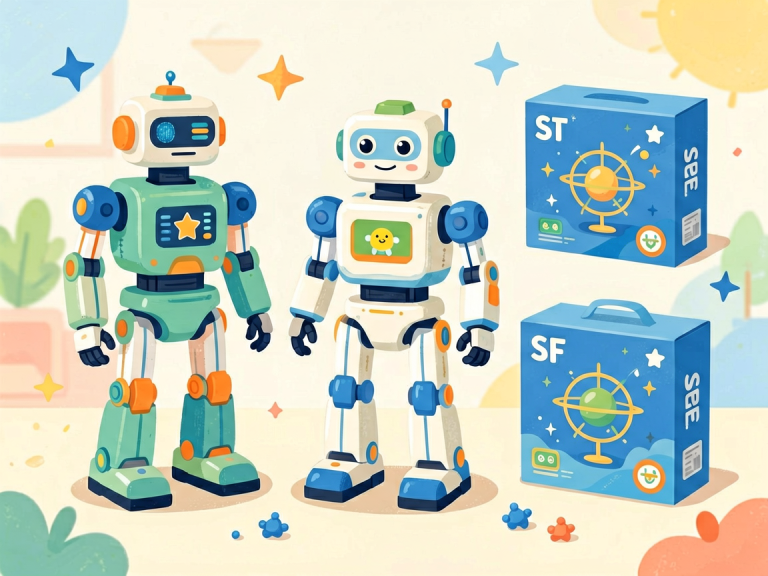
- STEM vs. Creative Thinking : A coding robot teaches logic and sequencing; a set of art markers teaches color mixing and self-expression. Both are valuable, but they serve different purposes. Compare which skill gap needs filling.
- Open-Ended vs. Closed-Ended : Open-ended toys (Lego bricks, play scarves, clay) can be used in countless ways and grow with the child. Closed-ended toys (a wooden puzzle with one correct solution) teach a specific skill and may have shorter play value. When comparing, consider how long the toy will stay interesting.
- Language and Social Skills : Board games and role-play sets (kitchen, doctor kit) encourage turn-taking, negotiation, and vocabulary building. Compare these with solitary toys like a single-player puzzle.
Tip: Read reviews from educators or occupational therapists, not just from parents. Look for phrases like “promotes fine motor precision” or “encourages collaborative storytelling.” Also compare the toy’s “failure mode” – does it teach resilience when it breaks or when a child makes a mistake? For example, a marble run that collapses teaches trial-and-error; a digital game that resets with a button teaches quick restart but not persistence.
Tip 3: Compare Safety and Durability – The Non-Negotiables
No amount of educational value justifies a toy that poses a choking hazard or contains toxic materials. When comparing toys, always prioritize safety certifications (e.g., ASTM, CE, EN71) and material quality. But safety comparisons go beyond checking a label – they involve evaluating the toy’s design in real-world scenarios.
Checklist for Safety Comparison
- Small Parts : For children under three, compare the size of detachable components. A button that fits through a toilet paper tube is a choking hazard.
- Sharp Edges and Pinch Points : Run your fingers along seams and hinges. Compare how smoothly moving parts operate. Cheaper toys often have rough plastic edges.
- Chemical Safety : Compare the paint and plastic used. Look for “BPA-free,” “phthalate-free,” and “lead-free” labels. Wooden toys should be finished with non-toxic lacquer.
- Cords and Strings : A pull-toy with a long cord can strangle a toddler. Compare cord length – anything over 12 inches is risky for infants.
- Battery Compartments : Compare whether the battery door requires a screwdriver to open. A magnetic or push-button compartment can be opened by a child.
Durability is also a safety concern – a toy that shatters into sharp shards is dangerous. When comparing two similar toys (e.g., two plastic cars), test the build quality: does it feel solid? Does the wheel wobble? Read reviews about breakage after a few weeks. A more expensive but sturdier toy often saves money in the long run because it won’t need replacing.
Tip 4: Compare Engagement Potential – Will It Hold Attention?
A toy that a child plays with for five minutes and then discards is a waste, regardless of its price tag. When comparing toys, assess their “sustained engagement quotient.” This involves considering how many ways the toy can be used, how much imagination is required, and whether it encourages repetitive play versus creative variation.
Factors That Boost Long-Term Play
- Multi-Use Features : A simple wooden train set can be rearranged into different tracks, combined with blocks, and used for storytelling. Compare it to a battery-operated train that travels only one route – the static train offers far more long-term value.
- Social Play : Toys that allow two or more children to play together (board games, team-building sets) often stay in circulation longer because they create shared experiences.
- Adaptability : Toys that can be used in different contexts (outdoor vs. indoor, alone vs. in groups) have higher engagement potential. Compare a sand and water table – it works in the backyard or on the deck, and it changes with seasons.
- Surprise and Mystery : Toys that have hidden elements, unboxing steps, or progressive challenges (like a complex Lego set with multiple stages) create novelty over time.
Tip: When comparing two toys, ask yourself: “After one week, will the child still be curious about this toy? After one month? After one year?” The best toys often reveal new possibilities the longer you play with them.
Tip 5: Compare Price and Value – Not All Expensive Toys Are Better
Cost is a major factor in toy comparison, but price does not equal quality. A $100 electronic interactive robot may break after three months, while a $30 set of simple wooden blocks might last a decade. When comparing, calculate cost per hour of play. If a toy is used for 100 hours, even a $50 price tag equates to 50 cents per hour – excellent value. But a $10 toy used only once costs $10 per hour, which is poor value.
Hidden Costs to Compare
- Batteries and Refills : Some toys require special batteries, ink cartridges, or replacement parts. Compare the ongoing cost. A toy that uses standard AA batteries is cheaper to maintain than one that needs a proprietary rechargeable pack.
- Space Requirements : A large playset may require a dedicated corner of the room. Compare the footprint. If you live in a small apartment, a bulky toy might become a nuisance.
- Assembly Time : Some toys come fully assembled; others require hours of setup. Compare the effort needed. For a busy parent, a toy that takes 45 minutes to assemble might not be worth it.
Practical comparison tip: Look for toys that grow with the child. A convertible crib-toddler-bed is a classic example. In toys, consider a set of magnetic tiles that can be used for flat patterns at age two and 3D structures at age eight. This “longevity” factor significantly increases value.
Tip 6: Compare Toy Categories – A Structured Framework
When you have a shortlist of candidates, organize your comparison using a simple table or mental checklist. Create categories such as:
| Criteria | Toy A (e.g., Wooden Puzzle) | Toy B (e.g., Electronic Tablet) |
|————————-|—————————–|———————————-|
| Age Appropriateness | 2–4 years | 3–6 years |
| Educational Skill | Fine motor, shape recognition | Hand-eye coordination, apps |
| Safety | No small parts, non-toxic paint | Battery compartment, screen time concerns |
| Durability | Very high | Moderate – screen may crack |
| Engagement Potential | Moderate – limited uses | High – many apps, but passive |
| Cost | $15 | $60 plus app purchases |
| Overall Value | Excellent for motor skills | Good for early tech literacy |
This framework allows you to see trade-offs clearly. For a child who needs tactile, hands-on play, Toy A wins. For a tech-savvy older child, Toy B might be acceptable with screen time limits.
Final Thoughts: Trust Your Judgment, But Compare Wisely
The toy industry is a multi-billion dollar machine designed to make you feel that every new product is essential. But the truth is, children thrive most with a small number of high-quality, thoughtfully chosen toys. By using these comparison tips – focusing on developmental fit, educational depth, safety, engagement, and true value – you can cut through the noise and select toys that bring genuine joy and learning.
Remember, the best toy is not necessarily the most expensive or the one with the most features. It is the one that aligns with the child’s unique world. Next time you find yourself standing in a toy aisle or scrolling through endless product listings, pause and apply this systematic comparison. Your child – and your wallet – will thank you.