The Art of Mindful Selection: How to Choose Toys That Nurture Baby’s Creativity
Introduction
In a world saturated with flashing lights, electronic melodies, and plastic gadgets, choosing the right toys for a baby has become a bewildering task for modern parents. The toy industry bombards caregivers with messages that brighter, louder, and more technologically advanced products are inherently better for development. Yet, mounting evidence from developmental psychology and neuroscience suggests the opposite: the most powerful toys for fostering creativity are often the simplest, most open-ended, and least prescriptive. Creativity is not a trait that suddenly emerges in adulthood; it is a fundamental cognitive capacity that begins to develop in infancy, shaped profoundly by the environment, including the objects a child interacts with. This article explores the science and art of selecting toys that not only entertain but actively cultivate the creative mind from the earliest months of life.
The Critical Link Between Play and Creativity
Before we can choose wisely, we must understand why creativity matters in infancy. Creativity is not merely about artistic expression; it is the ability to generate novel ideas, solve problems flexibly, and see multiple possibilities in a single situation. For a baby, every day is a creative endeavor. When a six-month-old discovers that shaking a rattle produces sound, or a one-year-old realizes that a wooden block can serve as a pretend telephone, they are engaging in the same mental processes that later produce inventions, artworks, and scientific breakthroughs. Play is the baby’s primary mode of learning, and the quality of that play is directly influenced by the toys available.
Research in developmental psychology, particularly the work of Alison Gopnik and her colleagues, shows that babies are natural-born scientists and artists. They form hypotheses, test them through actions, and revise their understanding based on outcomes. Toys that overly constrain this exploratory process—by dictating a single correct usage or by providing immediate, passive entertainment—can actually suppress creative thinking. Conversely, toys that invite multiple uses, encourage experimentation, and leave room for imagination act as catalysts for creative development.
Understanding Developmental Stages: What Babies Need at Each Phase
Choosing toys for creativity requires a nuanced understanding of how a baby’s cognitive, motor, and social-emotional capacities evolve. A toy that sparks creativity in a four-month-old will be meaningless to a fourteen-month-old, and vice versa.
0–6 Months: Sensory Exploration and Cause-Effect
In the first half-year, babies are primarily sensory beings. They explore the world through their mouths, eyes, ears, and hands. Creative development at this stage means building foundational neural connections: recognizing patterns, tracking movements, and experiencing varied textures. Ideal toys include soft fabric squares with different textures, unbreakable mirrors, high-contrast black-and-white picture cards, and simple rattles that produce gentle sounds. The key is variety without overstimulation. A toy that plays ten different songs at the push of a button may actually hinder creativity because it substitutes passive consumption for active discovery. Instead, a simple wooden ring that the baby can grasp, mouth, and drop over and over again teaches cause and effect in a way that demands the infant’s own agency.
6–12 Months: Object Permanence and Manipulation
As babies gain the ability to sit, crawl, and eventually stand, their play becomes more purposeful. They begin to understand that objects exist even when out of sight, and they delight in hiding and finding. This is the golden age for nesting cups, stacking rings, soft blocks, and simple shape sorters. However, the most creative toys at this stage are those that allow for multiple stacking configurations, not just a single predetermined sequence. A set of assorted wooden blocks, for instance, can be stacked, knocked down, lined up, or used as pretend food. The creativity lies in the child’s freedom to decide, not in the toy’s instructions.
12–18 Months: Symbolic Play and Early Pretend
Around their first birthday, babies begin to engage in symbolic play—using one object to represent another. This is the dawn of true imagination. A cardboard box becomes a car, a blanket becomes a cape, a spoon becomes a drumstick. Toys that support this emerging capacity include simple dolls, animal figures, play food, and vehicles without batteries. The less realistic the toy, often the more creative the play. A simple wooden block is more creatively potent than a detailed plastic fire truck with flashing lights, because the block can be anything the child needs it to be.
18–24 Months: Problem-Solving and Narrative
As toddlers approach age two, their play becomes more complex. They start to create simple narratives: “This bear is sleeping,” or “The car is going to the store.” They also begin to solve problems, like fitting a triangular peg into a triangular hole. Creative toys at this stage include puzzles with varying difficulty, construction sets with large pieces, art supplies like non-toxic crayons and finger paints, and open-ended materials like playdough. The critical factor is that the toy should allow for multiple solutions. A puzzle that has only one correct way to be solved teaches a specific skill, but a set of magnetic tiles that can be built into endless shapes teaches creativity itself.
Key Principles for Choosing Toys That Foster Creativity
Armed with developmental knowledge, parents can apply several evidence-based principles when evaluating toys.
Open-Endedness Over Closed-Ended Design
The single most important criterion is whether the toy can be used in many different ways. An open-ended toy has no predetermined outcome; it is a tool for the child’s imagination. Examples include blocks, balls, fabric scraps, cardboard boxes, sand, water, and playdough. A closed-ended toy, like a battery-operated toy that sings a specific song when a button is pressed, offers only one correct interaction. While such toys have their place—they can be calming or teach a specific cause-effect link—they should not dominate the toy collection. Research by developmental psychologist Jennifer M. Zosh and her colleagues at the Temple University Infant Lab found that infants showed greater exploratory play and more diverse actions with simple, open-ended toys compared to electronic ones.
Simplicity Over Complexity
Toy manufacturers often market “smart” toys as educational, but simplicity is frequently more conducive to creativity. A simple wooden train set with a few tracks and one engine invites the child to imagine destinations, create stories, and problem-solve when the tracks don’t fit. An elaborate electronic train that chugs around a fixed track on its own does the opposite: it trains the child to be a spectator. The simpler the toy, the more the child must contribute mentally. This is not to say that all simple toys are good—a plastic block with no texture or weight may be less engaging—but the guiding principle is that the child should be the active creator, not the passive receiver.
Sensory Richness Without Overstimulation
Babies learn through their senses, but there is a fine line between rich sensory input and overwhelming noise. Toys that engage multiple senses—sight, touch, sound, and sometimes taste—are beneficial, provided the sensory information is natural and variable. A wooden rattle that makes a gentle, irregular noise when shaken is more creative than a plastic toy that plays a fixed melody. The baby must experiment with force and angle to vary the sound, learning about the physical world in the process. Silks, bells, natural sponges, and wooden objects offer sensory variety without the artificial bombardment of electronic toys.
Opportunities for Failure and Revision
Creativity thrives in an environment where mistakes are welcomed as learning opportunities. Toys that allow for easy revision—blocks that can be restacked, sand that can be reshaped, or puzzles where pieces can be tried in multiple positions—encourage a growth mindset. Conversely, toys that punish mistakes (for instance, a shape sorter that only accepts the correct shape and does nothing else) can lead to frustration or rote memorization rather than creative problem-solving. The best toys are those that say “try again” rather than “you failed.”
Types of Toys That Consistently Foster Creativity
Beyond general principles, certain categories of toys have proven particularly effective in nurturing creative play.
Construction and Building Materials
Blocks, LEGO Duplo, magnetic tiles, and wooden planks are arguably the most creative toys ever invented. They demand spatial reasoning, planning, trial and error, and endless imagination. A single set of blocks can become a castle, a spaceship, a farm, or a bridge. For babies and toddlers, large, lightweight blocks that are easy to grasp and stack are ideal. The key is to provide enough pieces to allow for complex structures but not so many that the child becomes overwhelmed.
Art and Mark-Making Tools
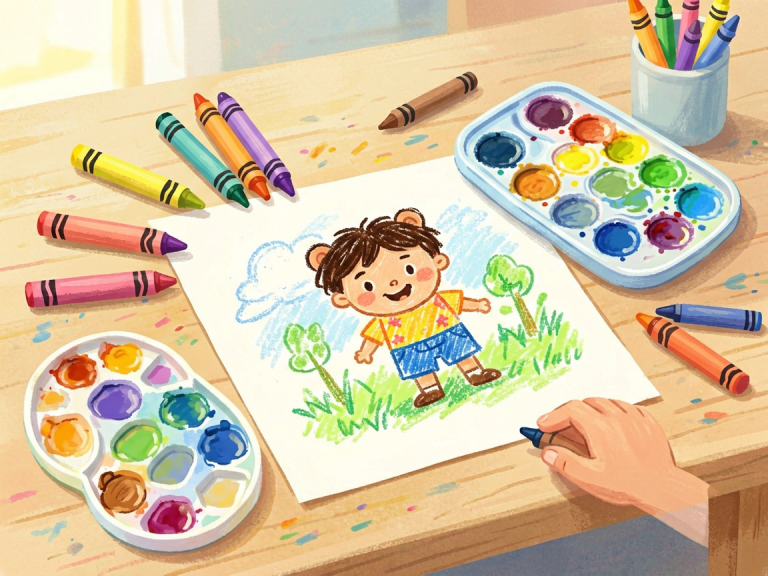
Even before a baby can hold a crayon properly, they can engage with art. Finger paints (edible and washable), large sheets of paper taped to the floor, and non-toxic stampers allow for sensory exploration and the joy of creating marks. Creativity at this stage is not about producing a recognizable image but about the process—the feeling of paint between fingers, the discovery that a handprint appears on paper. Parents should resist the urge to guide or correct; the baby’s own experimentation is the goal.
Pretend Play Props
Simple dolls, soft animals, play food, and dress-up items (like a soft hat or a scarf) invite symbolic play. The less realistic, the better. A simple wooden spoon can be a microphone, a drumstick, a wand, or a shovel. A piece of fabric can be a blanket, a roof, a cape, or a river. The child’s imagination does the heavy lifting. Avoid plastic replicas of everyday objects that make realistic sounds (e.g., a toy blender that actually whirs); these short-circuit the imaginative process by providing the sound for the child.
Natural and Household Objects
Some of the most creative toys are not toys at all. Babies are naturally drawn to wooden spoons, pots and pans, cardboard boxes, fabric scraps, pinecones, smooth stones, and empty containers. These objects are inherently open-ended because they have not been assigned a fixed function by a manufacturer. A cardboard box is a house, a car, a cave, a treasure chest. Providing a basket of “loose parts”—safe natural and household items—can stimulate hours of creative play. Studies in the Reggio Emilia educational approach emphasize the importance of such materials for fostering divergent thinking.
Music and Sound-Making Tools
Simple musical instruments—shakers, drums, xylophones, bells—allow babies to explore rhythm, volume, and cause and effect. Unlike a toy that plays a pre-recorded tune, a real instrument requires the child to create the sound. Even a baby banging a pot with a wooden spoon is engaging in creative musical exploration. The goal is not to produce a pleasant melody but to experiment with different sounds and patterns.
Practical Tips for Parents and Caregivers
Translating these principles into daily life requires intentionality and a shift in mindset.
Rotate Toys to Maintain Novelty
Babies, like adults, can become bored with a static collection. Rather than overwhelming the child with dozens of toys at once, keep only a few accessible and rotate them weekly. This maintains novelty and encourages deeper engagement with each toy. A block set that has been put away for a month will seem like a new discovery when brought out again.
Observe Before Intervening
When a baby is playing, resist the urge to demonstrate the “right” way to use a toy. If a child is stacking a block on its side, that is a valid exploration of balance. If they are banging two blocks together instead of stacking, they are exploring sound and texture. Creative play is self-directed. The parent’s role is to be a safe, attentive presence, not a director. Only intervene if the child shows frustration or asks for help.
Prioritize Quality Over Quantity
A small collection of well-chosen, high-quality open-ended toys is far more valuable than a room full of plastic electronic toys. Invest in few but durable items made from natural materials—wood, cotton, wool, metal. These materials not only feel better in the hands but also age gracefully and can be passed down. They also avoid the overstimulation of bright colors and flashing lights that often accompany plastic toys.
Embrace Mess and Imperfection
Creative play is often messy. Paint gets on clothes, blocks scatter across the floor, sand gets everywhere. Parents who can tolerate some disorder—within safety limits—will see their children thrive. Set up a designated play area where mess is allowed. Use washable materials. Consider that the mess is evidence of learning: the child is experimenting, testing boundaries, and creating. Cleanup can be part of the play process.
Encourage Loose Parts Play
Provide a “treasure basket” of safe, varied objects: a wooden egg, a metal whisk, a small cloth bag, a cork, a large button (supervised to prevent choking), a smooth stone. For babies who are no longer mouthing everything, this collection becomes a source of endless exploration. The objects have no single function, so the child must invent uses for them. This is creativity in its purest form.
Conclusion: Cultivating the Creative Mind from the Start
Choosing toys for babies is not about following trends or ticking boxes on a developmental checklist. It is about honoring the child’s innate curiosity, agency, and imaginative power. The most creative toys are those that whisper, “What else can you do with me?” rather than shouting, “This is how I work.” By selecting simple, open-ended, sensory-rich objects and respecting the child’s own play process, parents can create an environment where creativity blossoms naturally. In an age that often values speed, efficiency, and predetermined outcomes, the humble wooden block and the cardboard box stand as quiet rebels, inviting babies to think, dream, and invent. In doing so, they lay the foundation not just for future artistic or scientific achievements, but for a lifelong capacity to see the world as a place of possibility. And that is the greatest gift any toy can give.