Beyond Magnetic Tiles: Top Alternatives for Preschoolers Creative Play
Introduction
Magnetic tiles have become a staple in many preschool classrooms and playrooms, celebrated for their ability to click together effortlessly and inspire three-dimensional structures. Their translucent colors and satisfying magnetic snap appeal to both children and parents. Yet while they are undeniably engaging, magnetic tiles are not the only—or necessarily the best—tool for fostering a preschooler’s cognitive, motor, and imaginative development. They can be expensive, limited in textural variety, and sometimes too prescriptive in terms of structural possibilities. Fortunately, a wealth of excellent alternatives exists, each offering unique benefits that complement or even surpass what magnetic tiles provide. From classic wooden blocks to squishy modeling compounds, these alternatives encourage open-ended play, sensory exploration, and problem-solving in ways that resonate with the developmental needs of children aged three to five. This article explores five outstanding substitutes that every parent or educator should consider, highlighting their distinct advantages and how they can enrich a preschooler’s play experience.
Wooden Building Blocks: The Timeless Foundation of Spatial Thinking
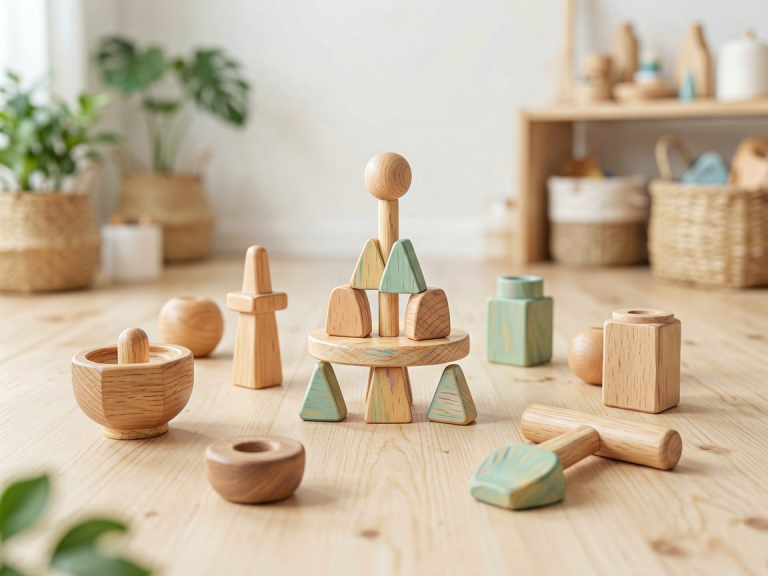
Wooden building blocks are arguably the most venerable alternative to magnetic tiles, and for good reason. Unlike magnetic tiles, which rely on a specific connecting mechanism, wooden blocks offer pure, unadulterated physics. A preschooler must learn to balance, stack, and counterweight each piece without the aid of magnetic attraction. This hands-on trial-and-error process hones fine motor control and spatial awareness in a way that is both challenging and satisfying. The tactile sensation of smooth, natural wood provides a grounding sensory experience that plastic or magnetized surfaces cannot replicate. Furthermore, wooden blocks come in a wide array of shapes—cubes, cylinders, arches, triangles, and planks—that invite more varied architectural forms than the standard square and triangle of magnetic tiles. A child can build a towering castle with a curved entrance, a bridge spanning two columns, or a simple road for toy cars. The lack of magnetic guidance means that every structure is a genuine feat of engineering, teaching resilience when towers tumble and encouraging iterative design. From a developmental standpoint, wooden blocks also excel at promoting cooperative play. Several children can work together on a single block city, negotiating space and sharing resources. And because they are typically made from sustainable materials and built to last for generations, wooden blocks are an environmentally friendly investment that grows with the child—far beyond the preschool years.
LEGO DUPLO: Precision and Thematic Storytelling
While magnetic tiles excel at creating geometric patterns and translucent windows, LEGO DUPLO offers a distinctly different kind of building experience that appeals strongly to preschoolers. DUPLO bricks are twice the size of standard LEGO pieces, making them safe for little hands and mouths, yet they retain the iconic interlocking system that teaches cause and effect. Every click of a DUPLO brick into place provides immediate, satisfying feedback—similar to the magnetic snap of tiles, but with a more deliberate, fine-motor challenge. The key strength of DUPLO lies in its integration with thematic playsets. A preschooler can build a farm with animals, a fire station with a sliding pole, or a train with moving wheels. These narrative elements ignite imaginative role-playing that goes beyond simple construction. While magnetic tiles tend to emphasize abstract architecture, DUPLO encourages storytelling, character interaction, and sequential thinking. Children learn to follow simple pictorial instructions (a precursor to reading) or invent their own scenarios, combining building with drama and social play. Moreover, DUPLO sets often include minifigures, animals, and accessories that expand the play possibilities exponentially. For parents seeking a building toy that bridges engineering with imaginative narrative, DUPLO is an unbeatable alternative. It also offers a clear progression path: as the child grows, DUPLO seamlessly transitions into classic LEGO, extending the toy’s lifespan for years.
Play Dough and Modeling Clay: Sculpting Creativity and Fine Motor Strength
One of the most overlooked alternatives to magnetic tiles is good old-fashioned play dough or modeling clay. While building toys focus on constructing from discrete units, play dough invites a fluid, malleable approach to creation that is profoundly different—and equally valuable. For preschoolers, squeezing, rolling, pinching, and flattening dough strengthens the small muscles in their hands and fingers, directly preparing them for writing and scissor use. Unlike the rigid connectivity of magnetic tiles, dough allows for organic forms: a lumpy dinosaur, a coil of a snake, a flattened pancake topped with pretend sprinkles. This open-ended medium encourages children to think in three dimensions without the constraints of predetermined shapes. They can also combine dough with simple tools like plastic knives, cookie cutters, and rolling pins to explore patterns, textures, and even early math concepts (e.g., making a “snake” of equal length as another). Another advantage is the sensory richness: the smell, temperature, and pliability of dough provide a calming, grounding experience that can help regulate a preschooler’s emotions. For parents concerned about mess, modern non-toxic, wheat-based doughs are easy to clean, and homemade versions using flour, salt, and cream of tartar are simple to prepare. While play dough does not produce permanent structures like magnetic tiles, the process—rather than the product—is where the true learning occurs. It is an essential alternative that nurtures creativity, patience, and sensory integration.
Cardboard Building Blocks and Recycled Materials: Eco-Friendly Engineering
For families seeking a low-cost, eco-conscious alternative, cardboard building blocks and recycled materials offer a fantastic outlet for construction. Unlike store-bought magnetic tiles, which are often made from plastic and magnets, cardboard blocks can be sourced from shipping boxes, paper towel rolls, and cereal cartons. With a bit of tape or simply by nesting, preschoolers can create towers, forts, tunnels, and even life-sized playhouses. The lightweight nature of cardboard makes it safe for even the most enthusiastic builder—tumbling walls are harmless—and the large scale of these blocks encourages gross motor movements as children lift, carry, and arrange them. This kind of physical play is rare with small magnetic tiles, which typically remain on a tabletop. Moreover, building with recycled materials teaches environmental stewardship and resourcefulness. A child learns that a forgotten box can become a castle, a robot, or a spaceship. Parents can involve children in the preparation: cutting shapes, decorating with markers or paint, and reinforcing edges with tape. This collaborative process builds vocabulary (e.g., “reinforce,” “flap,” “structure”) and problem-solving skills. Another advantage is the infinite variety—no two cardboard block sets are exactly the same, keeping play fresh and unpredictable. When the blocks eventually wear out, they can be recycled again, closing the loop. For preschools and homes on a budget, cardboard construction is a brilliant alternative that proves you do not need expensive magnetic tiles to inspire profound architectural play.
Magnetic Building Sticks and Balls: A Different Kind of Magnetic Experience
It may seem counterintuitive to include another magnetic toy as an alternative to magnetic tiles, but magnetic building sticks and balls—often sold under names like Tegu or GeoMag—offer a fundamentally different play experience. Instead of flat, rigid tiles that connect edge-to-edge, these systems use rods with magnetized ends that attach to steel spheres. This configuration allows for the creation of skeletal, open-frame structures: a cube becomes a wireframe, a tower becomes a slender lattice, a sphere can be surrounded by radiating sticks like a sun. For preschoolers, this introduces concepts of vertices, edges, and 3D geometry in a more visible way than the solid surfaces of magnetic tiles. The fine motor challenge is also distinct: a child must align the stick’s magnet precisely with the ball, requiring careful hand-eye coordination. Moreover, the resulting structures are often more flexible and can be bent or transformed into moving joints (some sets include hinges). This kinetic aspect adds an element of engineering that magnetic tiles lack. Safety is generally high because the magnets are encased in plastic, and the balls are large enough to prevent swallowing. For children who have mastered magnetic tiles and crave a new challenge, magnetic sticks and balls provide a wonderful next step. They also encourage spatial reasoning and symmetry, as children discover that a stable structure requires balanced distribution of rods. While not as common as magnetic tiles, this alternative deserves serious consideration for its unique ability to combine magnetism with skeletal construction.
Conclusion
Magnetic tiles are undeniably a valuable tool for preschool development, but they are far from the only option. Wooden building blocks offer timeless lessons in balance and physics; LEGO DUPLO weaves storytelling into construction; play dough enriches sensory and fine motor skills; cardboard blocks provide large-scale, eco-friendly engineering; and magnetic sticks and balls introduce a new dimension of spatial reasoning. Each alternative brings its own set of benefits, addressing different aspects of a child’s growth—cognitive, physical, social, and emotional. The best approach is not to replace magnetic tiles entirely, but to rotate and combine these alternatives, giving preschoolers a diverse palette of materials to explore. By stepping beyond the magnetic square, we open up a world of creativity, resilience, and joy that will serve children well beyond their preschool years.